Westinghouse iGen4500 vs WEN 56450i: Which Inverter Generator Should You Buy?
Finding a reliable 4,500-watt inverter generator isn’t difficult, but choosing between the Westinghouse iGen4500 vs WEN 56450i can be. Both are among the most popular portable inverter generators for RV owners, campers, homeowners, and anyone who needs dependable backup power. They offer electric start, clean inverter power, RV-ready outlets, and enough capacity to run essential appliances during a power outage.
Although they share many similarities, they’re not identical. The Westinghouse iGen4500 focuses on premium features like remote start, quieter operation, and a longer runtime. The WEN 4500 generator, on the other hand, delivers excellent performance at a lower price, making it a favorite among budget-conscious buyers.
In this comparison, we’ll look beyond the specifications to see how these inverter generators perform in real-world situations. By the end, you’ll know which model offers the better value for your needs.
Who Should Buy the Westinghouse iGen4500?
The Westinghouse iGen4500 is the better choice if you:
- Want the quietest operation.
- Plan to use your generator frequently.
- Value the convenience of remote start.
- Need the longest possible runtime.
- Don’t mind paying more for premium features.
It’s especially well suited for RV owners, homeowners who experience frequent outages, and users looking for a high-quality inverter generator that balances performance, convenience, and reliability.
Who Should Buy the WEN 56450i?
The WEN 4500 is an excellent option if you:
- Want to save money without sacrificing reliability.
- Need dependable backup power for occasional outages.
- Camp several times a year.
- Don’t need remote start.
- Want one of the best values in the 4,500-watt inverter generator class.
For many buyers, the WEN delivers nearly the same real-world performance as the Westinghouse while costing less, making it a smart choice for those on a budget.
Our Verdict
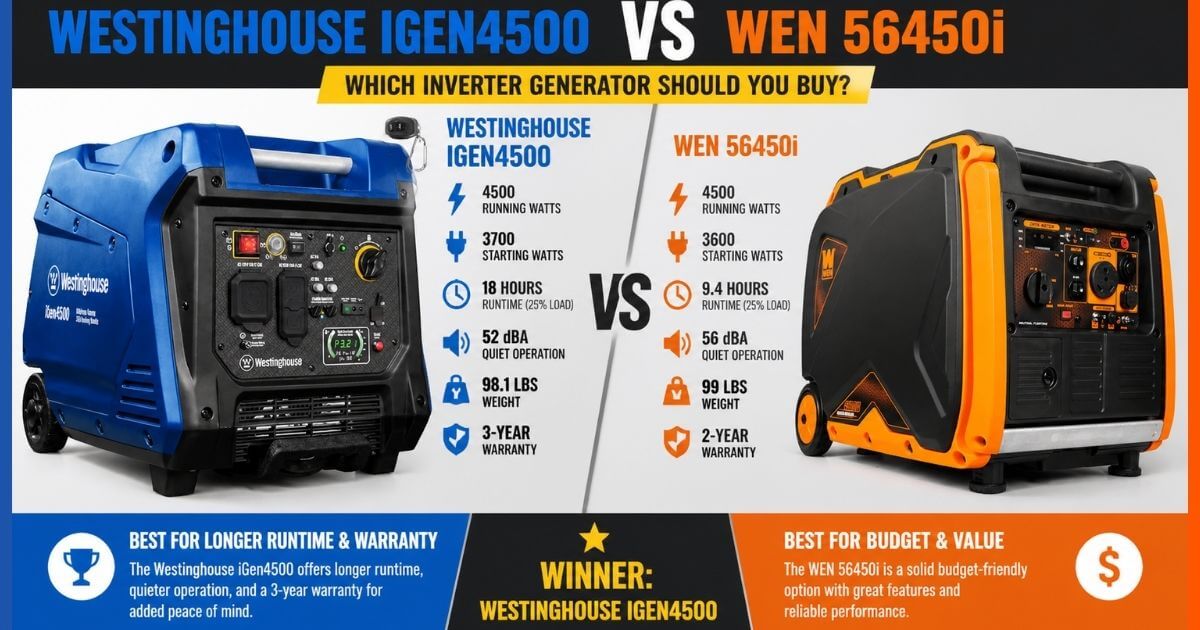
The Westinghouse iGen4500 is the better all-around generator. It offers slightly more running power, operates more quietly, runs longer on a full tank, and includes a remote start system that adds everyday convenience. If your budget allows, it’s the model we’d recommend to most buyers.
The WEN 56450i is an excellent alternative for anyone looking to save money without giving up the features that matter most. It delivers reliable power, clean electricity for sensitive electronics, and solid fuel efficiency. While it lacks remote start and isn’t quite as quiet, it remains one of the best values in its class.
Bottom line:
- Best Value: WEN 4500 ⭐⭐⭐⭐⭐
- Best Overall: Westinghouse iGen4500 ⭐⭐⭐⭐⭐
How We Compared These Generators
We compared the Westinghouse iGen4500 and the WEN 4500 using manufacturer specifications, owner manuals, long-term user feedback, and real-world performance data. Instead of focusing only on specifications, we evaluated how each generator performs in everyday situations such as RV camping, home backup, and powering sensitive electronics.
Our comparison considered the following factors:
- Power Output: Starting watts, running watts, and the ability to handle common household appliances.
- Fuel Efficiency: Fuel tank size, runtime, and Eco Mode performance.
- Noise Level: Manufacturer noise ratings and expected operating noise under different loads.
- Build Quality: Overall design, portability, wheel and handle quality, and ease of maintenance.
- Ease of Use: Starting options, control panel layout, and user-friendly features.
- Safety Features: Low-oil shutdown, overload protection, circuit breakers, and clean inverter power.
- Long-Term Value: Warranty, reliability, maintenance requirements, replacement parts availability, and overall ownership costs.
Rather than selecting a winner based on a single feature, we looked at which generator provides the best overall value for different types of users. The Westinghouse 4500 watt inverter generator offers more premium features and quieter operation, while the WEN 4500 delivers strong performance at a more affordable price.
Westinghouse iGen4500 Pros
Westinghouse iGen4500 Cons
- Higher 3,700W running output
- Quiet 52 dBA operation
- Remote, electric, and recoil start
- Up to 18-hour runtime
- Large 3.4-gallon fuel tank
- Premium build quality
- RV-ready and parallel-ready
- Higher purchase price
- Slightly bulky for one-person lifting
WEN 56450i Pros
WEN 56450i Cons
- Excellent value for the price
- Reliable 224cc engine
- Electric start
- Clean inverter power
- RV-ready and parallel-ready
- Good fuel efficiency
- Simple to maintain
- No remote start
- Slightly louder than the Westinghouse
- Slightly lower running wattage
Design and Build Quality
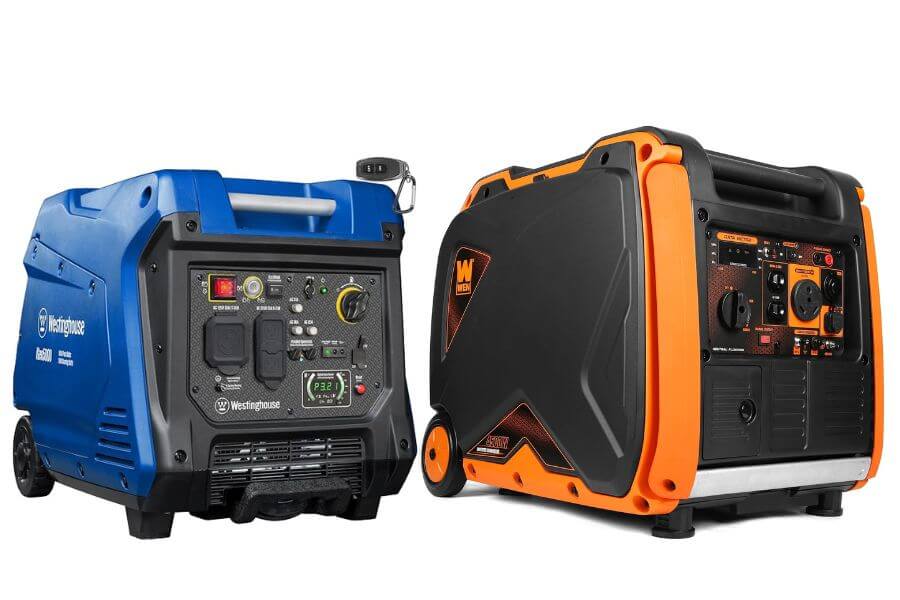
Both generators feature a fully enclosed inverter design that helps reduce operating noise while protecting internal components from dust and minor impacts. Compared to traditional open-frame generators, they also have a cleaner appearance and are easier to transport.
The Westinghouse iGen4500 has a more premium feel. The exterior panels fit together well, the telescoping handle feels sturdy, and the wheels roll smoothly across driveways, campgrounds, and other uneven surfaces. Small details, such as the layout of the controls and the overall finish, make it feel like a higher-end product.
The WEN 4500 uses a similar enclosed design and includes integrated wheels and a folding handle for easy transport. Its build quality is solid, especially considering its price, although some plastic components don’t feel quite as robust as those on the Westinghouse.
Maintenance is straightforward on both models. Routine tasks such as checking the oil, replacing the spark plug, and cleaning the air filter can all be completed without much difficulty.
Winner: Westinghouse iGen4500
Its slightly better fit and finish, combined with sturdier wheels and handle, give it the edge in overall build quality.
Portability
Despite producing up to 4,500 starting watts, both generators are designed to be moved easily.
| Feature | Westinghouse iGen4500 | WEN 4500 |
| Weight | 98 lbs | 100 lbs |
| Wheels | ✔ | ✔ |
| Telescoping Handle | ✔ | ✔ |
The two generators are nearly identical in size and weight. Both feature integrated wheels and suitcase-style handles, allowing one person to roll them across driveways, campsites, or garage floors.
The Westinghouse is slightly lighter and has a sturdier handle, giving it a small advantage when transporting the generator over uneven ground.
Winner: Westinghouse iGen4500 ⭐⭐⭐⭐⭐
The difference is minor, but the Westinghouse feels a bit more refined and easier to maneuver.
Power Output and Performance
When comparing generators, running wattage is often more important than peak wattage. Starting watts only help power appliances during startup, while running watts determine how much equipment the generator can support continuously.
Both generators produce 4,500 starting watts, making them capable of handling appliances with higher startup demands. The difference is in their continuous output.
| Generator | Starting Watts | Running Watts |
| Westinghouse iGen4500 | 4,500W | 3,700W |
| WEN 4500 | 4,500W | 3,600W |
The Westinghouse provides an extra 100 running watts. While that isn’t a huge difference, it gives you a little more flexibility when powering multiple appliances at the same time.
What Can They Power?
Both generators are suitable for powering essential household appliances and RV equipment, including:
- Refrigerator or freezer
- Microwave
- Television
- Wi-Fi router
- LED lights
- Laptop and phone chargers
- Coffee maker
- Small power tools
- Sump pump
- Most 13,500 BTU RV air conditioners
With proper power management, they can also handle some 15,000 BTU RV air conditioners, especially if the air conditioner is equipped with a soft-start device. However, results depend on the specific unit and any other appliances running at the same time.
Performance During Power Outages
For emergency home backup, both generators can comfortably keep essential appliances running.
A typical emergency setup might include:
- Refrigerator
- Freezer
- Several LED lights
- Internet modem and router
- Television
- Phone chargers
As long as you avoid running several high-wattage appliances simultaneously, either generator provides reliable backup power for most households.
Performance for RV Camping
These generators are popular with RV owners because they offer clean inverter power and include a built-in 30-amp TT-30R RV outlet.
They operate quietly, consume less fuel than conventional generators, and provide stable power for RV electronics. Whether you’re camping for a weekend or traveling across the country, both models are capable companions. Check our best RV generators.
Stable Power for Sensitive Electronics
One of the biggest advantages of inverter generators is their ability to produce clean electricity. Learn how THD matter in our portable generators.
Both the Westinghouse iGen4500 and the WEN 4500 maintain less than 3% Total Harmonic Distortion (THD), making them safe for devices such as:
- Computers
- Smartphones
- Tablets
- Gaming consoles
- Smart TVs
- CPAP machines
- Camera batteries
You won’t need to worry about the unstable voltage that is sometimes associated with conventional portable generators.
Real-World Performance
In everyday use, the difference between these two generators is relatively small.
The Westinghouse feels slightly more capable when several appliances are connected because of its higher running wattage. It also maintains that performance for a longer period thanks to its larger fuel tank.
The WEN, however, performs surprisingly close to the Westinghouse despite its lower price. For many homeowners and campers, the performance difference is unlikely to be noticeable.
Winner: Westinghouse iGen4500 ⭐⭐⭐⭐⭐
The Westinghouse earns a narrow victory thanks to its higher running wattage and slightly greater capacity for sustained loads. While the difference isn’t dramatic, it offers a little more flexibility when powering multiple appliances.
Fuel Efficiency and Runtime
A generator that runs longer on a single tank requires fewer refueling stops, making it more convenient during extended power outages or multi-day camping trips.
Both models use an automatic Eco Mode, which adjusts engine speed to match the electrical load. This improves fuel efficiency, reduces noise, and helps extend engine life.
Fuel Tank and Runtime
| Feature | Westinghouse iGen4500 | WEN 56450i |
| Fuel Tank Capacity | 3.4 gallons | 2.9 gallons |
| Runtime @ 25% Load | Up to 18 hours | Up to 16 hours |
The Westinghouse’s larger fuel tank gives it a runtime advantage of approximately two hours under light loads.
That extra runtime can be useful if you’re:
- Running overnight during a power outage
- Camping for several days
- Powering a refrigerator continuously
- Sleeping while using a CPAP machine
Fuel Economy
Actual fuel consumption depends on several factors, including:
- Electrical load
- Ambient temperature
- Fuel quality
- Altitude
- Generator maintenance
Under light loads, both generators are highly fuel-efficient. As the load increases, fuel consumption naturally rises, but the inverter system helps prevent unnecessary fuel waste by adjusting engine speed automatically.
Eco Mode
Both generators include an Eco Mode that lowers engine RPM when power demand is low.
Benefits include:
- Longer runtime
- Lower fuel consumption
- Reduced engine wear
- Quieter operation
For most users, Eco Mode should remain enabled unless powering equipment with frequent, heavy startup loads.
Which Generator Is More Efficient?
Both models are economical, but the Westinghouse offers a slight advantage because of its larger fuel tank and longer runtime.
If you only use your generator occasionally, the difference may not matter much. However, during long outages or extended camping trips, fewer refueling stops become a noticeable convenience.
Winner: Westinghouse iGen4500 ⭐⭐⭐⭐⭐
The iGen4500 wins this category with its longer runtime and larger fuel tank, making it the better choice for users who value extended operation without interruption.
Noise Level Comparison
One of the biggest reasons people choose an inverter generator is quiet operation. Whether you’re camping, tailgating, or using a generator during a power outage, lower noise levels make the experience much more comfortable.
Both the Westinghouse iGen4500 and the WEN 4500 are considerably quieter than conventional open-frame generators. Their enclosed designs and inverter technology allow the engine to adjust its speed based on the electrical load, reducing both noise and fuel consumption.
Noise Specifications
| Generator | Rated Noise Level* |
| Westinghouse iGen4500 | 52 dBA |
| WEN 56450i | 58 dBA |
*Noise ratings are manufacturer figures measured under controlled conditions. Actual noise levels vary depending on load, distance, and surroundings.
On paper, the Westinghouse is quieter. While a 6 dBA difference may not seem large, it is noticeable in real-world use, especially when the generators are operating under light or moderate loads.
Real-World Experience
During light loads, both generators are quiet enough for conversation nearby. They won’t produce the constant loud engine noise associated with many traditional portable generators.
As more appliances are connected, engine speed increases and both generators become louder. However, the Westinghouse generally maintains a smoother and less noticeable engine sound.
The WEN remains reasonably quiet, but under heavier loads its engine noise is more apparent.
Which Is Better for RV Camping?
If you regularly camp in RV parks or public campgrounds, quieter operation is a significant advantage.
The Westinghouse is the better choice because:
- It produces less noise during normal operation.
- It’s less likely to disturb neighboring campers.
- It provides a more comfortable outdoor environment.
That said, the WEN is still much quieter than most conventional generators and is suitable for camping in most situations. We picked some Best Quiet Generators for our readers.
Winner: Westinghouse iGen4500 ⭐⭐⭐⭐⭐
Both generators are quiet, but the Westinghouse stands out with lower operating noise and a more refined engine sound.
Control Panel and Outlets
A well-designed control panel makes it easier to connect appliances, monitor the generator, and access important controls. Both the Westinghouse iGen4500 and the WEN 4500 have user-friendly layouts with clearly labeled outlets and switches, making them suitable for both beginners and experienced users.
Westinghouse iGen4500
The Westinghouse iGen4500 features a well-organized control panel with all essential outlets and controls positioned on the front of the generator for easy access. It includes:
- Two 120V 20A household outlets (5-20R)
- One 120V 30A RV outlet (TT-30R)
- Two USB charging ports (5V)
- Parallel connection ports
- Digital data center display
- Eco Mode switch
- Circuit breaker
- Ground terminal
- Electric start button
The digital display provides useful operating information such as voltage, frequency, lifetime running hours, and remaining runtime (depending on operating conditions). This allows you to monitor the generator without additional equipment.
The inclusion of remote start is another convenience feature. You can start or stop the generator using the included key fob, which is especially useful for RV camping and home backup.
WEN 56450i
The WEN 4500 watt inverter generator also offers a practical and easy-to-use control panel with most of the same essential connections. It includes:
- Two 120V 20A household outlets (5-20R)
- One 120V 30A RV outlet (TT-30R)
- Two USB charging ports (5V)
- Parallel connection ports
- Digital display
- Eco Mode switch
- Circuit breaker
- Ground terminal
- Electric start button
The digital display shows important operating information, including voltage, frequency, total runtime, and maintenance reminders, helping users keep track of generator performance and service intervals.
Although the layout is simple and functional, it does not include the remote start capability found on the Westinghouse.
Side-by-Side Comparison
| Feature | Westinghouse iGen4500 | WEN 56450i |
| 120V Household Outlets | 2 | 2 |
| 30A RV Outlet (TT-30R) | ✔ | ✔ |
| USB Charging Ports | 2 | 2 |
| Parallel Ports | ✔ | ✔ |
| Digital Display | ✔ | ✔ |
| Eco Mode | ✔ | ✔ |
| Ground Terminal | ✔ | ✔ |
| Circuit Breaker | ✔ | ✔ |
| Remote Start | ✔ | ✘ |
Which Control Panel Is Better?
Both generators provide all the outlets most users need for RV camping, home backup, and recreational use. The layouts are intuitive, clearly labeled, and easy to navigate.
The Westinghouse iGen4500 has a slight advantage because its digital display provides more useful information, while the wireless remote start makes everyday operation much more convenient. This is especially helpful when the generator is being used for RV camping or home backup, as you can start or stop it without having to walk over to the generator. However, if remote start is not an important feature for you, the WEN 4500 still offers nearly the same overall functionality at a lower price, making it a strong choice for buyers who want to save money without giving up the essential features.
Winner: Westinghouse iGen4500 ⭐⭐⭐⭐⭐
The Westinghouse wins this category thanks to its more refined control panel, informative display, and the added convenience of remote start. The WEN 4500 still performs well, but it lacks the premium features that give the iGen4500 the edge.
Starting System and Ease of Use
A generator should be easy to start when you need it most, especially during emergencies. Both models include electric start, but the Westinghouse adds a feature that many users quickly come to appreciate: wireless remote start.
Starting Options
| Feature | Westinghouse iGen4500 | WEN 4500 |
| Electric Start | ✔ | ✔ |
| Recoil Start | ✔ | ✔ |
| Remote Start | ✔ | ✘ |
The Westinghouse can be started three ways:
- Wireless remote
- Electric push-button start
- Manual recoil start
The WEN offers:
- Electric start
- Manual recoil start
The remote start on the Westinghouse is particularly useful when the generator is placed outside during bad weather or connected to an RV. Being able to start or stop the generator without walking to it adds a level of convenience that many owners appreciate.
The WEN doesn’t include this feature, but its electric starter is reliable and easy to use.
Winner: Westinghouse iGen4500 ⭐⭐⭐⭐⭐
Thanks to its wireless remote start and slightly more refined control panel, the Westinghouse offers a more convenient user experience.
Safety Features
Both generators include the essential safety features expected from a quality inverter generator.
Shared Safety Features
- Low-oil shutdown
- Overload protection
- Circuit breakers
- Ground terminal
- Eco Mode
- Low THD (<3%) for sensitive electronics
These features help protect both the generator and your connected appliances during normal operation.
Neither model includes a carbon monoxide (CO) shutdown sensor on the original versions, so it’s essential to operate them outdoors in a well-ventilated area and follow all safety guidelines in the owner’s manual.
Winner: Tie ⭐⭐⭐⭐⭐
Both generators provide the key safety features needed for reliable and safe operation. Neither has a significant advantage in this category.
Maintenance and Long-Term Reliability
A portable generator is a long-term investment, so reliability and proper maintenance are important factors to consider before buying. A generator may perform well when new, but regular servicing is what helps keep the engine running smoothly and reliably over the years.
Both the Westinghouse iGen4500 and WEN 4500 use 224cc OHV gasoline engines and have similar routine maintenance requirements. Regular oil changes, air filter inspections, spark plug checks, and proper fuel storage are important for keeping either generator in good working condition.
Neither model is particularly difficult to maintain, and basic service can be handled by most owners with some mechanical knowledge. Common maintenance items are also relatively easy to find, which makes routine servicing and long-term ownership more convenient.
Routine Maintenance
To keep either generator running reliably, you’ll need to perform the following maintenance:
| Maintenance Task | Recommended Interval* |
| Check engine oil | Before every use |
| Change engine oil | After the break-in period, then as recommended in the owner’s manual. |
| Clean or replace air filter | Inspect regularly |
| Inspect spark plug | Periodically |
| Check fuel system | Before long-term storage |
| Run the generator | Every few months if stored |
*Always follow the maintenance schedule in the owner’s manual for your specific model.
Regular maintenance not only improves reliability but also helps maximize fuel efficiency and engine life.
Engine Reliability
Both generators have earned a solid reputation for dependable performance when properly maintained.
The Westinghouse iGen4500 is known for its smooth operation, consistent power output, and durable construction. Many owners use it regularly for RV camping, home backup, and recreational activities with few issues beyond routine maintenance.
The WEN 4500 has also built a strong reputation as a dependable budget-friendly inverter generator. While it may not feel quite as premium as the Westinghouse, it performs reliably for most homeowners and campers.
Parts Availability
Maintenance items such as:
- Air filters
- Spark plugs
- Engine oil
- Recoil starter components
- Wheels
- Batteries
are readily available for both generators through authorized dealers and online retailers.
This makes routine servicing straightforward and helps keep long-term ownership costs reasonable.
Warranty
Both generators include a 3-year limited residential warranty, offering similar coverage for manufacturing defects.
As with any warranty, coverage depends on following the manufacturer’s maintenance and operating guidelines.
Which Generator Is More Reliable?
Neither generator has a significant reliability advantage.
If maintained properly, both should provide many years of dependable service.
The Westinghouse feels slightly more refined in terms of overall build quality, while the WEN stands out for delivering dependable performance at a more affordable price.
Winner: Tie ⭐⭐⭐⭐⭐
Both generators have a strong track record of reliability. Regular maintenance is far more important than the small differences between these two models.
Final Verdict
The Westinghouse iGen4500 and WEN 4500 are two of the best inverter generators in the 4,500-watt class. Both deliver clean, stable power, are RV-ready, and provide reliable performance for camping, emergency home backup, and outdoor use.
If you’re looking for the best overall generator, the Westinghouse iGen4500 is the clear winner. Its quieter operation, longer runtime, remote start, and slightly higher running wattage make it a more refined and convenient machine for long-term ownership.
However, if your goal is to get the best value for your money, the WEN 56450i is difficult to beat. It offers nearly the same core performance, dependable reliability, and clean inverter power at a lower price, making it an outstanding choice for budget-conscious buyers.
Final Ratings
| Generator | Overall Rating |
| Westinghouse iGen4500 | ⭐ 9.7/10 |
| WEN 4500 | ⭐ 9.4/10 |
Our Recommendation:
- Choose the Westinghouse iGen4500 if you want premium features and the best overall experience.
- Choose the WEN 4500 if you want excellent performance and value while spending less.
Frequently Asked Questions
Does the Westinghouse iGen4500 Offer Better Value?
If you value quieter operation, remote start, and longer runtime, the extra cost is justified. These features improve convenience, especially during frequent use.
Can both generators run an RV air conditioner?
Yes. Both can power many 13,500 BTU RV air conditioners. Some 15,000 BTU units may also work, particularly if equipped with a soft-start device, but results depend on the air conditioner and the total electrical load.
Are these generators safe for laptops and TVs?
Yes. Both produce clean inverter power with low THD, making them suitable for sensitive electronics.
Which generator is quieter?
The Westinghouse iGen4500 is quieter, with a rated noise level of approximately 52 dBA compared to about 58 dBA for the WEN 4500.
Can I connect two generators together?
Yes. Both models are parallel-ready, but you should only use a compatible parallel kit approved by the manufacturer.