Briggs & Stratton P4500 Review
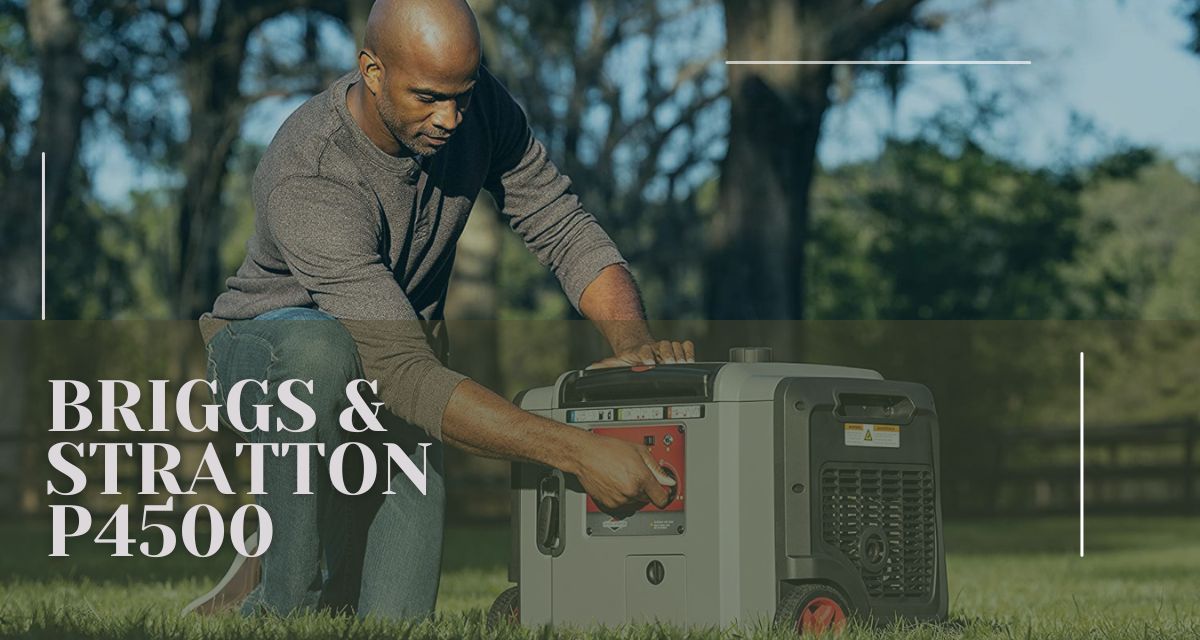
The Briggs & Stratton P4500 is a 4,500-watt inverter generator with a 224cc engine that produces 3,700 running watts and 4,500 starting watts.
It features a 3.5-gallon fuel tank, CO Guard, wheels, a telescoping handle, and a 30-amp RV-ready outlet. Its combination of power and portability makes it a practical choice for RVs and backup power.
At around 104 pounds, however, it is fairly heavy, and the U.S. version provides 120V power rather than 240V.
In this review, we look at its power, fuel use, noise, portability, outlets, safety features, RV suitability, advantages, limitations, and overall value.
Who Should Buy the Briggs & Stratton P4500?
The P4500 is a good match for:
RV owners: The 30A RV outlet and 3,700 running watts make it particularly useful for many RV setups.
Homeowners needing essential backup power: It can power selected appliances and devices during an outage.
Campers and outdoor users: It provides considerably more power than small camping generators.
Users who want inverter power: The inverter system is useful for electronics and quieter operation.
People who want easier movement: The wheels and telescoping handle make rolling easier than carrying the entire generator.
Who Should Consider Another Generator?
The P4500 may not be the best option if your main priority is portability.
A smaller 2,000-watt-class inverter generator will generally be easier to transport.
You should also look elsewhere if you specifically need 240V output or enough capacity for heavy-duty equipment and multiple high-demand appliances.
Likewise, if you only need to power a few small electronic devices, paying for a generator this large may not make much sense.
How We Reviewed the Briggs & Stratton P4500
Our review is based on the generator’s published specifications, features, operating design, outlet configuration, safety systems, fuel capacity, and intended applications.
We also considered how the generator fits common use cases such as RV power, camping, outdoor equipment, and emergency household backup.
We did not treat the manufacturer’s maximum runtime or wattage figures as guarantees of everyday performance. Generator performance changes with electrical load, operating conditions, and the equipment connected to it.
We also looked at the practical limitations of the P4500, including its weight, 120V-only output, and different model configurations.
The goal is to help you decide whether the P4500 fits your actual power requirements rather than simply repeating its specifications.
Briggs & Stratton P4500 Pros
Briggs & Stratton P4500 Cons
- 3,700 running watts
- 4,500 starting watts
- Inverter technology
- 30A RV outlet
- Up to 16 hours at 25% load
- CO Guard protection
- Low-oil shutdown
- Wheels and telescoping handle
- Useful multifunction display
- Electric or remote start depending on model
- About 104 pounds
- No 240V output
- Larger than small camping generators
- Different versions have different features
- High-power loads can quickly use its available capacity
Design and Build Quality
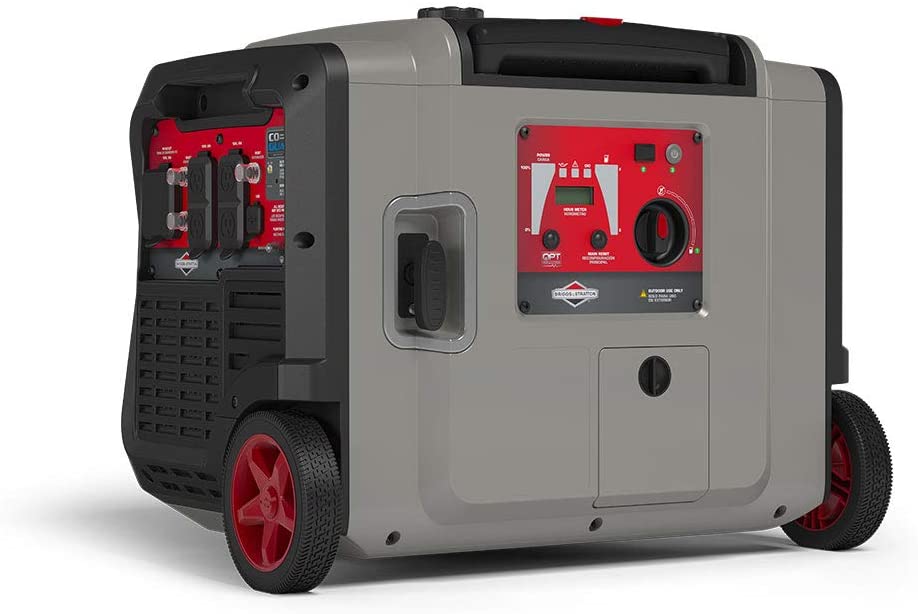
The P4500 has a fully enclosed housing that gives it a cleaner appearance than a traditional open-frame generator. This design also covers and protects many of the internal components while helping keep engine noise more contained.
The main tradeoff is portability. At around 104 pounds, the P4500 is not easy to lift or carry for long distances. The wheels and telescoping handle make a big difference when moving it across a driveway, campsite, garage, or other smooth surface. However, stairs, rough ground, or loading it into a vehicle can still be challenging.
For buyers, the key point is simple: the enclosed design offers better protection and a more refined package, but you should have a plan for moving the generator when lifting is required.
Engine and Power Performance
The P4500 uses a 224cc engine and provides 3,700 running watts.
That is enough power for many common household and outdoor applications. Depending on the actual power requirements, it can handle equipment such as refrigerators, lights, televisions, chargers, coffee makers, microwaves, and other moderate electrical loads.
It can also be useful for RV owners because the available power gives you more flexibility than a typical 2,000-watt inverter generator.
The important thing is to understand the difference between running and starting watts.
Running watts are the amount of electricity an appliance normally needs while operating. Starting watts are the additional power some motor-driven appliances require when they start.
For example, a refrigerator or air conditioner may need considerably more power for a short period when its compressor starts.
The P4500’s 4,500-watt starting capacity helps with these temporary demands, but you still need to calculate the combined load of the appliances you plan to operate.
Fuel Efficiency and Runtime
The P4500 has a 3.5-gallon fuel tank and is rated for up to 16 hours of runtime at 25% load.
That figure is useful for comparing generators, but it should not be treated as the runtime you will always get.
A generator running a small electrical load uses less fuel than one working close to its maximum output. If you connect several high-power appliances, fuel consumption will increase and runtime will decrease.
The P4500 also uses load-based engine control. When electrical demand is lower, the engine can operate at a lower speed instead of running unnecessarily hard.
This can help reduce fuel consumption and operating noise during lighter loads.
Noise Level
Briggs & Stratton rates the P4500 at around 61 dB under its specified test conditions. This figure is a reference measurement, not a guarantee that the generator will always operate at exactly 61 dB.
Actual noise can change with the distance from the generator, electrical load, surroundings, and operating conditions. The P4500’s inverter system can also adjust engine speed as power demand changes, which can help reduce unnecessary engine noise during lighter loads.
It is still a gasoline-powered generator, so some engine sound is expected. However, its enclosed design and inverter technology make it better suited to RVs, camping, and residential backup than many open-frame models.
Control Panel and Outlets
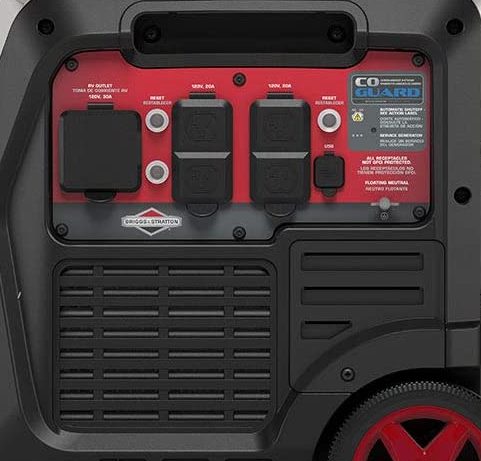
The U.S. P4500 provides a useful selection of outlets for everyday power needs.
The control panel includes:
- Four 120V 20A household outlets
- One 120V 30A RV outlet
- Two USB ports
- A multifunction display
The 30A RV outlet is one of the most useful features for campers with compatible RV electrical systems.
The display can provide information such as fuel level, runtime, and power usage. This makes it easier to understand how hard the generator is working and how much operating time you may have remaining.
The exact control layout and starting features can vary between P4500 versions, so check the model number before purchasing.
Inverter Technology
One of the main advantages of the P4500 is its inverter design.
Instead of sending raw alternator output directly to the outlets, an inverter generator converts and regulates the electrical output electronically.
This produces cleaner and more stable power that is well suited to many modern electronic devices.
That makes the P4500 a useful option for powering equipment such as:
- Laptops
- Televisions
- Smartphones and chargers
- Gaming equipment
- Small electronic devices
- Other sensitive consumer electronics
You should still follow normal electrical safety practices and stay within the generator’s rated capacity.
Safety Features
The P4500 includes several features designed to help protect both the generator and the user.
One of the most important is CO Guard.
Carbon monoxide is an invisible and potentially deadly gas produced by gasoline engines. The CO Guard system is designed to shut the generator down when dangerous carbon monoxide levels are detected.
This is an additional safety feature, not a reason to operate the generator indoors.
The P4500 should always be operated outdoors in a well-ventilated area and positioned safely away from buildings, doors, windows, and other openings.
It also includes low-oil shutdown, which helps protect the engine if the oil level becomes too low.
Portability
Portability is a mixed area for the P4500.
The wheels and telescoping handle make it much easier to move around a driveway, campsite, RV area, or other relatively smooth surface.
The problem is its weight.
At approximately 104 pounds, the P4500 is considerably heavier than small inverter generators designed primarily for camping and light-duty use.
So, while you can roll it fairly easily, moving it up stairs or lifting it into a truck can require assistance.
This is an important consideration if you expect to transport the generator frequently.
Is the P4500 Good for RV Use?
Yes. RV use is one of the areas where the P4500 makes a lot of sense. However, there are more efficient models that can be your best RV generators in 2026.
The combination of 3,700 running watts and a 30A RV outlet gives it enough capacity for many common RV electrical needs.
It can potentially power appliances such as an RV refrigerator, lights, television, microwave, coffee maker, and air conditioner, depending on their individual power requirements.
The biggest thing to check is the air conditioner’s starting demand.
An RV air conditioner can require a substantial amount of power when its compressor starts. If the air conditioner uses a large startup surge, there may not be enough remaining capacity for several other high-power appliances at the same time.
For this reason, check the actual wattage requirements of your RV equipment rather than assuming that every appliance can run together.
What Can the Briggs & Stratton P4500 Run?
The P4500 can handle many everyday electrical loads, provided their combined demand stays within its capacity.
For example, it may be suitable for running a refrigerator, lights, television, chargers, and other smaller devices at the same time.
It can also handle higher-demand appliances such as a microwave or coffee maker, but adding several high-power appliances together can quickly increase the total load.
The best approach is to add the running watts of the appliances you expect to use and then consider their starting requirements.
Remember that the generator provides 3,700 watts continuously, not 4,500 watts continuously.
The 4,500-watt figure is the starting capacity.
Can the P4500 Run an RV Air Conditioner?
It can run some RV air conditioners, but there is no universal yes or no answer.
Different RV air conditioners have different running and startup requirements.
A smaller or more efficient air conditioner may work comfortably within the generator’s capacity. A unit with a high starting surge may use a large portion of the available power.
If you plan to use the P4500 for an RV air conditioner, check both the running watts and startup requirements of the specific AC unit.
You should also avoid starting several large appliances at the same time.
Starting System
The P4500 is available in different configurations, and the starting system can vary between models.
Some versions use electric start, while other versions provide remote starting and additional connectivity features.
This is important because online listings can sometimes use the general P4500 name without making the exact configuration clear.
Before buying, check the complete model number and confirm whether it has the starting system and features you want.
Does the P4500 Have 240V Power?
No. The U.S. P4500 provides 120V power.
This is not a problem for most of the equipment it is designed to power, including many household appliances and RV equipment.
However, some larger appliances and equipment require 240V power.
Examples can include certain well pumps, electric ranges, central air-conditioning systems, and heavy workshop equipment.
If 240V output is one of your requirements, the P4500 is not the correct choice. Therefore, we have picked some best 50amp generators that can fulfill your requirements.
Briggs & Stratton P4500 vs. a Smaller Inverter Generator
A smaller inverter generator is easier to carry and usually makes more sense if you only need power for a few small devices.
The P4500 is the better option when you need considerably more capacity.
For example, someone who only wants to charge phones, run a laptop, power lights, and watch television may not need a generator this large.
An RV owner who wants to run larger appliances has a stronger reason to choose the P4500.
The trade-off is simple: more power means more size and weight.
Briggs & Stratton P4500 vs. a Larger Open-Frame Generator
A larger open-frame generator can provide more power and may offer 240V capability.
That makes a larger model more appropriate for heavy-duty equipment and some whole-home backup applications.
The P4500 takes a different approach.
It focuses on portability, inverter power, quieter operation, and RV-friendly functionality rather than maximum output.
If you need moderate portable power and want inverter technology, the P4500 can be a better fit.
If your priority is maximum power for demanding equipment, a larger generator may be more appropriate.
Final Verdict
The Briggs & Stratton P4500 is a portable inverter generator designed for users who need more power than a smaller compact generator can provide.
With 3,700 running watts and 4,500 starting watts, it can handle a range of RV, camping, outdoor, and essential home-backup needs. The 30-amp RV outlet is useful for RV owners, while the inverter design provides stable power for electronics and other sensitive equipment.
Its 3.5-gallon fuel tank and claimed runtime of up to 16 hours at 25% load can also be useful when longer operating time is important. The wheels and telescoping handle make it easier to move on suitable surfaces, but its approximately 104-pound weight means it is not a lightweight generator to carry.
The main limitation is that the U.S. version provides 120-volt power, so it is not intended for applications that require 240-volt output. Its size and weight may also be more than necessary for someone who only needs basic portable power.
Overall, the P4500 is best suited to RV owners, campers, outdoor users, and homeowners who need a higher-output portable inverter generator and do not require 240-volt power.