Westinghouse WGen7500 Review: Power, Runtime & Home Backup
The Westinghouse WGen7500 is a gasoline-powered portable generator designed for homeowners who need substantial backup electricity during power outages. It delivers 7,500 running watts and 9,500 peak watts, offers 120V and 240V output, and includes electric starting with a remote control.
Those features make it worth considering for people who want to operate selected household appliances and essential circuits when utility power fails. However, its size, noise level, fuel requirements, and conventional generator design mean it is not the right choice for every buyer.
In this Westinghouse 7500 watt generator review, we examine its published specifications, fuel capacity, runtime, outlets, home-backup suitability, limitations, and the types of buyers who should consider other options.
Who Should Buy the Westinghouse WGen7500?
Homeowners preparing for outages: It is worth considering if you need substantial power for selected household circuits and have a safe outdoor location.
People with 120V and 240V equipment: The outlet configuration can be useful when your intended loads require both voltage options.
Buyers who prefer remote starting: The included remote-start capability provides an additional starting option.
People who can keep a heavy generator in a planned location: Its wheels assist with movement, but the weight makes frequent lifting inconvenient.
Who Should Consider Another Generator?
RV owners who need a direct connection: The standard WGen7500 is not listed as RV-ready. An RV-ready model may be more convenient.
Buyers who want propane capability: This standard version is gasoline-only. Look at a verified dual-fuel model if using propane is important.
People who prioritize quiet operation: A suitable quiet inverter generator may be a better fit.
Users with sensitive electronics: Check the device requirements carefully because the listed THD is up to 23%.
Buyers who need lightweight portability: A smaller generator may be easier to transport and store if your power needs are modest.
Pros
Cons
- 7,500 running watts and 9,500 peak watts.
- 120V/240V output.
- Electric, remote, and recoil starting.
- 6.6-gallon gasoline tank.
- Published runtime of up to 11 hours at 25% load.
- GFCI-protected household outlets.
- Digital display for voltage, frequency, and operating hours.
- Suitable for selected home-backup loads with proper electrical installation.
- Heavy at approximately 196 pounds.
- Conventional open-frame generator rather than an inverter model.
- Noise rating listed at 72 dBA.
- Gasoline-only operation.
- Not listed as RV-ready.
- THD listed at up to 23%, which may not suit some sensitive electronics.
- The standard listing does not include a carbon monoxide sensor.
Who Is the Westinghouse WGen7500 For?
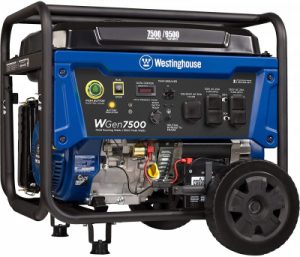
The ideal buyer is a homeowner who experiences power outages and wants a gasoline generator capable of powering several essential appliances or selected household circuits. Its 7,500-watt rated output provides considerably more capacity than many small portable generators.
It may also suit people who need temporary power for compatible tools, equipment, or other demanding electrical loads like Champion 7500 watt generator. The 120V/240V output is useful when the equipment requires either voltage, provided the combined demand stays within the generator’s limits.
The WGen7500 is less suitable for buyers who want a lightweight generator, quiet operation, built-in propane capability, or verified low-distortion output for sensitive electronics.
Before choosing it, consider what you need to power, how long you expect to operate the generator, where you will place it outdoors, and whether you can safely move and store a unit weighing nearly 200 pounds.
How We Reviewed the Westinghouse WGen7500
This review uses manufacturer specifications, published product documentation, and comparisons of the generator’s stated capabilities with common buyer requirements. We did not physically test the WGen7500, so the article does not present independent measurements of its runtime, fuel consumption, noise, durability, or starting performance.
The ratings and recommendations below are editorial assessments based on the documented specifications and intended uses, not results from hands-on testing.
Engine and Power Output
The WGen7500 uses a 420cc, four-stroke overhead-valve engine. Westinghouse rates the generator at 7,500 running watts and 9,500 peak watts.
Running watts represent the power available for sustained operation. Peak watts provide additional short-term capacity for compatible equipment that needs extra power when starting. Peak output should not be treated as continuous operating capacity.
For a homeowner, the difference matters when choosing which appliances to operate together. Refrigerators, freezers, lights, televisions, routers, and selected pumps may be suitable loads, depending on their electrical requirements. Larger equipment, especially motors and compressors, can draw considerably more power during startup.
The generator’s total output also needs to be considered alongside the capacity of each individual outlet. Having 7,500 running watts does not mean every outlet can deliver that amount of power independently.
Can the WGen7500 power a house?
It can provide backup electricity for selected household circuits when connected through a suitable, code-compliant setup. Whether it can handle your intended appliances depends on their combined running wattage, starting demand, voltage requirements, and how the circuits are arranged.
For example, a household might prioritize refrigeration, lights, internet equipment, and selected outlets during an outage. Adding a large air conditioner, well pump, or other motor-driven appliance requires a separate load calculation because its starting demand may be substantial.
Do not assume the generator can operate every appliance simultaneously. Prepare a list of essential loads and check their electrical requirements before buying. For a connection to household wiring, consult a qualified electrician about a compatible transfer switch or other approved arrangement.
Fuel Tank Capacity and Runtime
The WGen7500 has a 6.6-gallon gasoline tank. Westinghouse advertises runtime of up to 11 hours at 25% load.
That figure is a manufacturer-published estimate under a specified load condition, not a promise that the generator will run for 11 hours in every situation. A heavier electrical load generally increases fuel consumption, so runtime may be shorter when several appliances are operating.
For buyers preparing for an outage, fuel planning is an important part of the decision. Estimate which appliances you will run, how many hours per day they will operate, and how much gasoline you can safely obtain and store in approved containers.
The WGen7500 is gasoline-only. Do not assume it can operate on propane or natural gas simply because other Westinghouse models offer dual-fuel capability. If you want fuel flexibility, compare the specifications of a clearly identified dual-fuel version, such as the WGen7500DFc, separately.
Starting System and Ease of Use
The standard WGen7500 includes electric starting, remote starting, and a recoil backup-starting method. Electric starting can be convenient when the generator is positioned outdoors and you want to avoid repeatedly pulling a starter cord.
The remote key fob adds another option for starting the unit, but it does not remove the need to follow the manufacturer’s startup procedure or confirm that the generator is ready to operate safely.
The generator also includes a digital VFT display. It provides information about voltage, frequency, and accumulated operating hours. These readings help users monitor basic operating information, although they do not replace proper inspection or the manufacturer’s service instructions.
For a buyer who expects to use a generator during stressful weather or an outage, straightforward controls and a familiar startup procedure can be valuable. Read the owner’s manual before an emergency rather than waiting until utility power has failed.
Outlet Panel and Electrical Compatibility
The standard WGen7500 provides two 120V GFCI-protected duplex household receptacles and one 120/240V L14-30R twist-lock outlet.
This arrangement supports a variety of compatible electrical loads. The household receptacles can serve suitable 120V equipment, while the L14-30R outlet may be used for compatible 120/240V connections within its ratings.
However, outlet availability does not guarantee that every appliance or cable is compatible. Check the plug type, voltage, current requirements, and starting demand of the equipment you plan to use.
The WGen7500 is listed as transfer-switch ready. This can be useful for buyers planning backup power for selected household circuits, but a suitable transfer switch and correctly installed wiring are still required. Never connect a generator to household wiring through an ordinary wall outlet.
Is the WGen7500 RV-ready?
Westinghouse lists the standard WGen7500 as not RV-ready. It does not include the dedicated RV receptacle commonly used for direct connection to an RV’s shore-power inlet.
That does not mean every possible RV-related application is automatically impossible, but you should not assume it can plug directly into your RV. Verify the RV’s electrical requirements, the generator’s outlet configuration, and the suitability of any approved connection equipment before purchasing.
If RV use is your main reason for buying a generator, an RV-ready model with a compatible outlet may be a simpler option. Check our top picked generators for RV.
Noise Level: Is It Suitable for Residential Areas?
Westinghouse lists the WGen7500 at 72 dBA. This is a manufacturer-provided figure, not a guarantee of the sound level at every distance or under every load condition.
The generator uses a conventional open-frame design rather than an enclosed quiet inverter configuration. Buyers should therefore expect noticeable engine noise, especially when operating close to the house or neighbouring properties.
If you live in a densely populated area, check local generator-noise rules and consider where the unit can be positioned safely. Distance and surroundings affect how much sound reaches living spaces, but the generator must never be placed indoors or moved into an enclosed area to reduce noise.
For buyers who prioritize quiet operation for camping or residential use, a suitable inverter generator may be a better alternative.
Build, Weight, and Portability
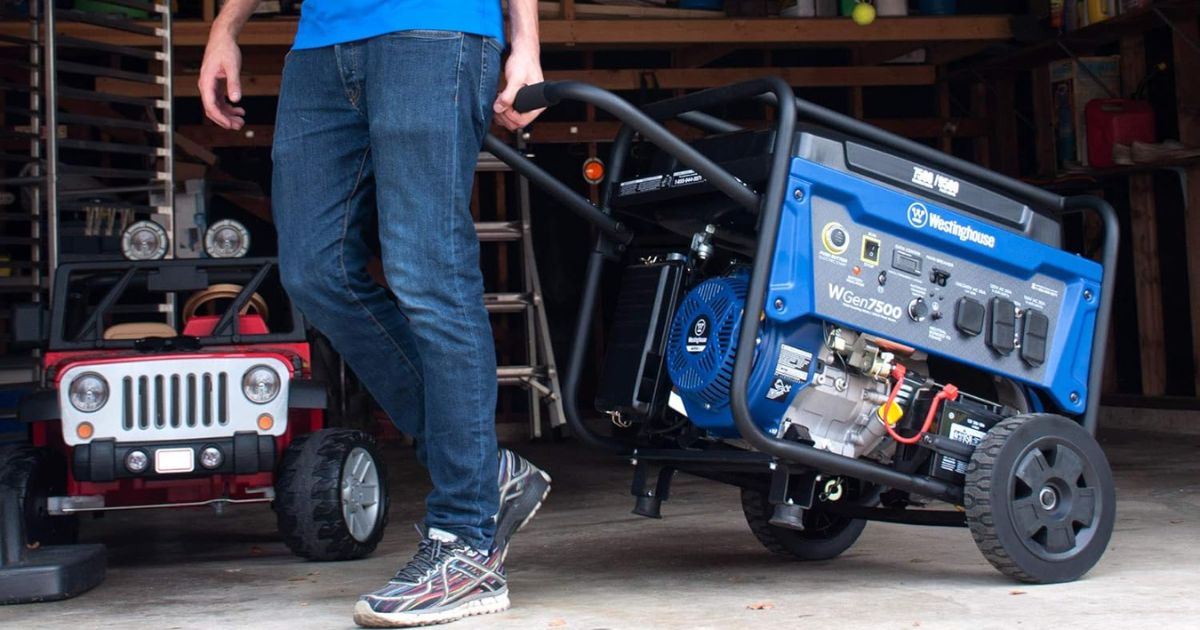
The WGen7500 has a steel frame, wheels, and a handle to assist with moving it. Its dry weight is approximately 196 pounds, so it is best viewed as a heavy wheeled portable generator rather than a lightweight unit.
The wheel kit can make movement easier across appropriate surfaces, but it does not make the generator easy to lift into a vehicle or carry over stairs. Consider your storage location and the route between storage and operating position before buying.
The frame and wheels are useful practical features for a generator of this size. However, they should not be treated as proof of a particular lifespan or resistance to damage. Long-term durability depends on the actual unit, operating conditions, storage, and following the manufacturer’s instructions.
Power Quality and Sensitive Electronics
The WGen7500 is a conventional generator, not an inverter generator. Westinghouse lists its total harmonic distortion (THD) at up to 23%.
That figure is important for buyers planning to power computers, televisions, networking equipment, audio devices, or other electronics with specific power-quality requirements. The generator’s high wattage does not automatically mean its output is suitable for every sensitive device.
Automatic voltage regulation helps manage voltage, but it should not be confused with a guarantee of low THD. Buyers should check the requirements of their equipment and compare them with the generator’s documented output characteristics.
If you need power for sensitive or expensive electronics, consider a model with verified power-quality specifications that match those requirements. An appropriate power-conditioning device may help in some situations, but it should not be used to overlook an equipment manufacturer’s stated requirements.
Safety Features and Important Limitations
The WGen7500 includes automatic low-oil shutdown, overload protection, GFCI-protected household outlets, and automatic voltage regulation, according to its published specifications.
These features address different concerns. Low-oil shutdown helps protect the engine, overload protection helps respond to excessive electrical demand, and GFCI protection can reduce the risk of electric shock in certain fault conditions. None makes unsafe operation acceptable.
One important limitation is that the standard WGen7500 listing says it does not include a carbon monoxide sensor. Buyers should not assume the generator will automatically shut down if carbon monoxide accumulates.
Always operate the generator outdoors, well away from doors, windows, vents, and other openings where exhaust could enter a building. Never operate it inside a home, garage, basement, shed, or RV, even with doors or windows open. Follow the manual’s instructions for grounding, electrical connections, weather protection, and fuel handling. Install working carbon monoxide alarms as directed by their manufacturers and applicable local requirements.
Westinghouse WGen7500 vs. a Quiet Inverter Generator
The best choice depends on the type of power you need.
The WGen7500 is designed around substantial output and conventional home-backup applications. It may suit a homeowner who wants to power several selected appliances and can accommodate a heavy, open-frame generator.
A quiet inverter generator may be more appropriate if you need easier transport, lower noise, or documented low-distortion power for sensitive electronics. Some inverter models also offer remote starting or higher output, so compare the exact specifications instead of assuming every inverter generator is small or low-powered.
For household backup, the most important question is whether the generator can support your intended loads and whether its outlet configuration matches your installation. For camping or light recreational use, portability and noise may matter more than maximum wattage.
Final Verdict
The Westinghouse WGen7500 is a conventional gasoline generator aimed at buyers who need substantial power for selected household circuits, equipment, or other demanding loads. Its 7,500 running watts, 120V/240V output, remote and electric starting, and 6.6-gallon fuel tank make it a practical candidate for planned backup power.
However, its limitations are important. The unit weighs about 196 pounds, its published noise rating is 72 dBA, and it is not an inverter generator. It also lacks a dedicated RV-ready outlet and is listed with THD of up to 23%, so it may not be the right match for every electronic device or recreational application.
For a homeowner who needs gasoline-powered backup capacity and has a safe, practical location for the generator, the WGen7500 is worth comparing with other conventional generators. Buyers who need quieter operation, propane capability, easier transport, or verified low-distortion power should compare alternatives before deciding.
Before purchasing, confirm the exact model and manual, calculate your intended electrical loads, review the current warranty terms, and plan a safe connection method for any household circuits.
Frequently Asked Questions
How long can the WGen7500 run on a full tank?
Westinghouse advertises up to 11 hours on its 6.6-gallon gasoline tank at 25% load. Actual runtime depends on the connected load and operating conditions.
Does the WGen7500 run on propane or natural gas?
The standard WGen7500 is gasoline-powered. Do not confuse it with a separately identified dual-fuel model.
Can the WGen7500 power a house?
It can supply selected household circuits through a suitable, code-compliant connection. The number and type of appliances it can support depend on their combined running wattage, starting requirements, and voltage needs.
Is the WGen7500 suitable for an RV?
Westinghouse lists the standard model as not RV-ready. Confirm the RV’s power requirements and the suitability of any proposed connection before buying.
Is the WGen7500 an inverter generator?
No. It is a conventional generator with automatic voltage regulation. Its listed THD is up to 23%, so buyers with sensitive electronics should check their equipment requirements carefully.
How heavy is the Westinghouse WGen7500?
Its listed dry weight is approximately 196 pounds. The wheels help with movement on suitable surfaces, but loading or lifting the generator may require assistance.
Does it have a carbon monoxide sensor?
The standard product listing says it does not include a carbon monoxide sensor. Always operate it outdoors, far away from openings into occupied buildings, and use appropriate carbon monoxide alarms.