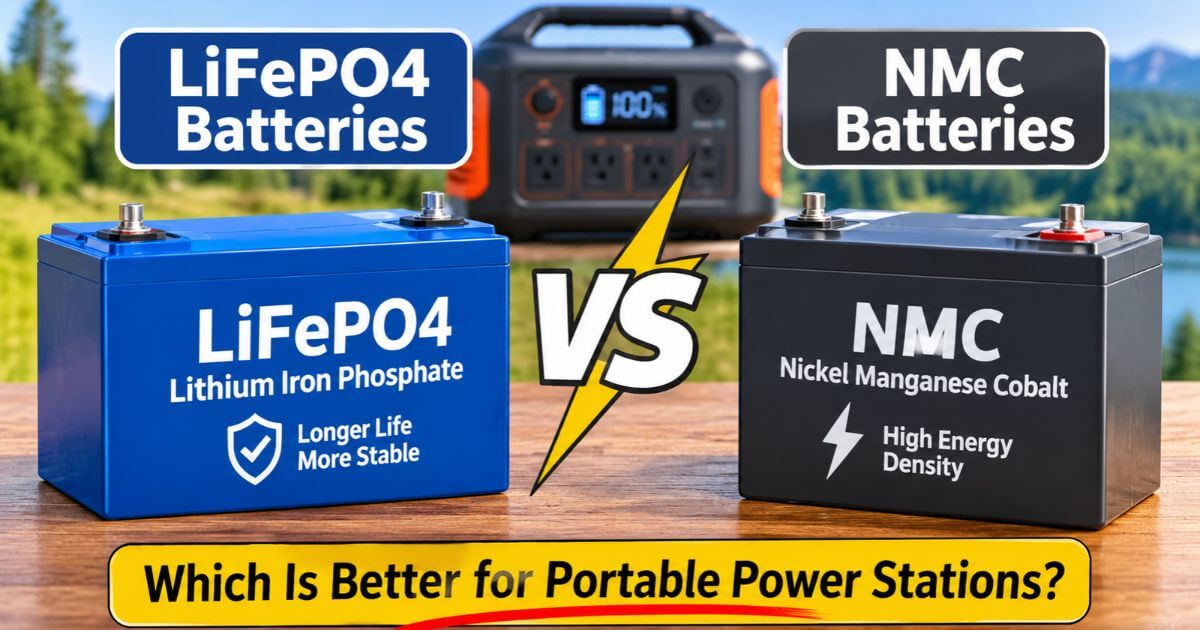
LiFePO4 vs NMC Batteries: Which Is Better for Power Stations?
The type of battery inside a portable power station affects how much energy it can store, how long it may last, and how easy the unit is to carry. Two chemistries commonly found in these products are LiFePO4 and NMC.
Although both belong to the lithium-ion battery family, they are designed around different priorities. LiFePO4 is often preferred for its durability and thermal stability, while NMC offers a higher amount of stored energy for its weight.
Understanding these differences can help you avoid buying a power station that does not match your needs.It is a type of lithium-ion battery that uses iron phosphate as its cathode material.
In this guide, we compare LiFePO4 vs NMC batteries to help you choose the right portable power station for home backup, camping, RV use, or everyday power needs.
LiFePO4 vs NMC Batteries: Quick Comparison
Here is a quick overview of the main differences.
| Feature | LiFePO4 (LFP) | NMC |
| Full name | Lithium Iron Phosphate | Lithium Nickel Manganese Cobalt Oxide |
| Cycle life | Generally longer | Generally shorter |
| Energy density | Lower | Higher |
| Battery weight | Generally heavier | Generally lighter |
| Thermal stability | Higher | Lower |
| Frequent daily use | Excellent choice | Depends on product |
| Portability | Less weight-efficient | Better weight efficiency |
| Long-term value | Often better for frequent use | Depends on purchase price and usage |
These are general differences, not guaranteed specifications. Actual performance depends on the battery cells, battery management system, product design, and operating conditions.
1. What Is a LiFePO4 Battery?
LiFePO4 is the abbreviation for lithium iron phosphate, a battery chemistry commonly used in portable power stations and energy storage systems.
You may also see it called LFP.
This battery chemistry is widely used in portable power stations, solar energy storage systems, RVs, and off-grid applications.
Its biggest advantages are its long cycle-life potential and relatively high thermal stability.
Advantages of LiFePO4
Longer battery lifespan: LiFePO4 batteries generally support more charging and discharging cycles than conventional NMC batteries. Some portable power station manufacturers advertise ratings of 2,000–6,000 cycles or more.
However, always check the conditions behind the rating. For example, a manufacturer may specify how many cycles the battery can complete before retaining 80% of its original capacity.
Better thermal stability: LiFePO4 generally has better thermal stability than NMC chemistry. This makes it an attractive option for home backup and applications involving frequent battery use.
Good for regular charging: If you use your power station every day, a longer cycle life can make a meaningful difference to its long-term value.
Disadvantages of LiFePO4
LiFePO4 also has some limitations:
- Lower energy density than NMC in many comparisons.
- Generally heavier for the same battery capacity.
- May require more physical space.
- Charging below freezing temperatures may require protection or battery heating.
For buyers who prioritize minimum weight, these limitations are worth considering.
2. What Is an NMC Battery?
NMC stands for lithium nickel manganese cobalt oxide.
It is another rechargeable lithium-ion battery chemistry used in electric vehicles, consumer electronics, and some portable power stations.
Its main advantage is higher energy density compared with typical LiFePO4 cells.
In simple terms, an NMC battery can store more energy relative to its weight or volume. This allows manufacturers to design compact and lightweight battery packs.
Advantages of NMC
Higher energy density: NMC batteries generally offer more energy per kilogram than LiFePO4 batteries. This can make a power station easier to carry.
Compact design: Manufacturers can use NMC chemistry when designing smaller products with a particular energy capacity.
Useful for weight-sensitive applications: If you regularly carry your power station while travelling or camping, a lighter model may be more convenient.
Disadvantages of NMC
- Generally shorter cycle life than LiFePO4.
- Lower thermal stability compared with LiFePO4.
- Frequent cycling may lead to greater capacity degradation over time.
- Actual lifespan varies significantly between battery models.
NMC batteries are not automatically unsafe or poor-quality. A properly designed NMC power station can be a suitable choice for many buyers.
3. Battery Lifespan: Which One Lasts Longer?
The difference in expected lifespan is an important factor when comparing LiFePO4 and NMC batteries.
Every rechargeable battery gradually loses some of its original capacity. This is called battery degradation.
LiFePO4 generally offers a longer cycle life, making it particularly attractive for people who use their power stations regularly. Aslo read our blog on Why Does a Solar Generator Stop Charging at 80%?
The following are broad illustrative ranges, not guaranteed ratings for every product:
| Battery chemistry | Illustrative cycle-life range |
| LiFePO4 | 2,000–6,000+ cycles |
| NMC | 500–1,500 cycles |
One complete battery cycle is counted when the total energy used adds up to the battery’s full capacity. You do not have to discharge the battery from 100% to 0% in one session.
For example, using 50% today and another 50% later represents approximately one equivalent full cycle.
How Long Can a Battery Last?
Consider two hypothetical power stations:
- LiFePO4 model: 3,000 rated cycles.
- NMC model: 800 rated cycles.
If each completes one equivalent full cycle every day:
| Battery | Rated cycles | Time to reach rated cycles |
| LiFePO4 | 3,000 | About 8.2 years |
| NMC | 800 | About 2.2 years |
These calculations show the time needed to reach the stated cycle counts. They are not guaranteed replacement dates.
Actual lifespan also depends on temperature, charging habits, storage conditions, and calendar aging.
Buying tip: Do not compare cycle counts alone. Check whether the manufacturer measures cycles until the battery retains 80%, 70%, or another percentage of its original capacity.
4. Battery Safety: Is LiFePO4 Safer Than NMC?
Safety is important when choosing a power station for your home, vehicle, or camping trips.
Both LiFePO4 and NMC batteries require proper protection. However, LiFePO4 generally has better thermal stability.
This means it is more resistant to thermal runaway under comparable conditions.
Thermal runaway is a dangerous process in which rising battery temperature can trigger further heating and potentially cause a fire.
NMC batteries can also operate safely when properly manufactured and protected. Their safety depends on cell quality, temperature management, and battery design.
Why Is a Battery Management System Important?
The BMS keeps track of the battery pack’s condition and helps prevent unsafe operating conditions.
Depending on the product, it may provide protection against:
- Overcharging.
- Excessive discharging.
- Overcurrent.
- Short circuits.
- Unsafe battery temperatures.
- Cell voltage imbalance.
A good BMS is important for both battery chemistries.
Buyer advice: Do not choose a power station based on battery chemistry alone. Check its safety features, manufacturer reputation, warranty, and relevant safety certifications.
5. Weight and Portability: Which Is Better for Camping?
If you regularly travel with a portable power station, weight matters.
NMC batteries generally have higher energy density. This allows manufacturers to build lighter or smaller battery packs for a similar energy capacity.
LiFePO4 batteries generally need more weight and space to store the same amount of energy.
However, the total weight of a power station also depends on its inverter, housing, cooling system, and other components. Check our top picked Bluetti Solar Generators.
Which Should Campers Choose?
Choose an NMC model if minimum weight and compact size are your main priorities.
Choose LiFePO4 if you want a power station for frequent camping, RV use, or long-term ownership.
If you transport your power station in a car rather than carrying it over long distances, the additional weight of LiFePO4 may not be a major concern.
6. Charging Speed and Temperature Performance
Battery chemistry is only one of several factors that influence how quickly a battery can recharge.
It also depends on:
- Battery capacity.
- AC charging input.
- Solar charging input.
- Charger power.
- Battery temperature.
- Battery management system.
For instance, a 1,000Wh LiFePO4 power station equipped with a 1,000W charging input could fill its battery sooner than a 1,000Wh NMC unit limited to a 500W input. However, the total charging time also varies depending on energy losses during charging and how the unit adjusts its charging rate as the battery level increases.
What About Hot and Cold Weather?
High temperatures can accelerate battery degradation in both chemistries. LiFePO4 generally offers better thermal stability, but it should still be kept within the manufacturer’s temperature limits.
Low temperatures may limit the amount of energy a battery can deliver and slow down its charging process.
Charging many conventional lithium-ion cells below 0°C without suitable protection can cause permanent damage.
Some power stations include battery heating systems or automatically prevent charging when the battery is too cold.
Before buying: Check the manufacturer’s operating, charging, and storage temperature limits, especially if you live in a hot climate or plan to use your power station outdoors.
7. Which Battery Offers Better Value for Money?
A power station with LiFePO4 chemistry may cost more upfront in some comparisons. However, its longer cycle-life potential can make it a better investment for frequent users.
Consider this simplified example:
| Specification | LiFePO4 | NMC |
| Purchase price | $600 | $450 |
| Rated cycle life | 3,000 | 800 |
| Cost per rated cycle | $0.20 | $0.56 |
The calculation is:
Purchase price ÷ Rated cycle life = Cost per rated cycle
In this example, the LiFePO4 model has a lower cost per rated cycle despite its higher purchase price.
This is only an illustration. It assumes comparable cycle-rating conditions and does not account for calendar aging, electricity costs, repairs, or warranty coverage.
For a fair comparison, check the actual battery capacity, cycle-rating conditions, and capacity-retention percentage.
8. Which Battery Should You Buy?
Choosing the right battery type comes down to your power needs and how you intend to use the power station.
| Your intended use | Suggested choice | Reason |
| Home backup | LiFePO4 | Longer cycle-life potential |
| Frequent power outages | LiFePO4 | Suitable for repeated cycling |
| RV or van life | LiFePO4 | Good for regular use |
| Off-grid solar | LiFePO4 | Long-term energy storage |
| Lightweight camping | NMC | Higher energy density |
| Occasional emergency use | Either | Compare overall specifications |
| Frequent daily charging | LiFePO4 | Generally longer cycle life |
Before Purchasing, Check These Five Things
Battery chemistry is important, but it is not the only specification that matters.
- Battery capacity: Check the watt-hour (Wh) rating to understand how much energy the power station stores.
- Inverter output: Check continuous and surge wattage to ensure it can operate your appliances.
- Cycle-life rating: Look at the rated number of charge cycles and how much battery capacity remains after completing those cycles.
- Warranty: Read the warranty period and battery-related conditions.
- Weight and charging input: Compare actual product weight and AC/solar charging specifications.
These details will help you avoid choosing a power station that has the right battery chemistry but does not meet your electricity requirements.
Final Verdict: LiFePO4 vs NMC – Which Is Better?
Both battery chemistries have advantages.
LiFePO4 is generally the better choice for buyers who want a power station for regular use, home backup, RV living, or off-grid applications. Its longer cycle-life potential and better thermal stability make it attractive for long-term ownership.
NMC is worth considering when you need a lighter and more compact power station, particularly for weight-sensitive travel.
Our recommendation: If you are buying a portable power station for frequent use, start by comparing LiFePO4 models. If portability is your biggest priority, consider NMC models as well.
Most importantly, compare the actual battery specifications, inverter output, warranty, charging performance, and product weight before making your final decision.
Frequently Asked Questions
1. Is LiFePO4 better than NMC for portable power stations?
For most buyers who use their power stations regularly, LiFePO4 is generally the better choice because of its longer cycle-life potential and higher thermal stability. NMC may be preferable when weight and compact size are more important.
2. How many years does a LiFePO4 battery last?
Battery lifespan varies based on how often it is used, the surrounding temperature, how it is stored, and the overall quality of its cells. A battery rated for 3,000 cycles could reach that cycle count after approximately 8.2 years of daily cycling, but this does not guarantee an 8.2-year lifespan.
3. Are NMC batteries safe?
Yes, properly manufactured and protected NMC batteries can operate safely. However, they generally have lower thermal stability than LiFePO4 batteries. Effective battery control and protection against extreme temperatures help maintain safe operation and long-term performance.
4. Can I replace an NMC battery with LiFePO4?
Not unless the manufacturer specifically approves the replacement. The two chemistries have different voltage characteristics and charging requirements. Using an incompatible battery can damage the power station or create safety risks.
5. Which battery is better for solar generators?
LiFePO4 is generally a strong choice for solar generators that are charged and discharged frequently. Its longer cycle-life potential makes it suitable for regular solar energy storage.
6. Does a LiFePO4 battery last forever?
No. LiFePO4 batteries also lose capacity through use and natural aging. They generally last longer in terms of charging cycles, but their actual lifespan depends on how they are used and maintained.