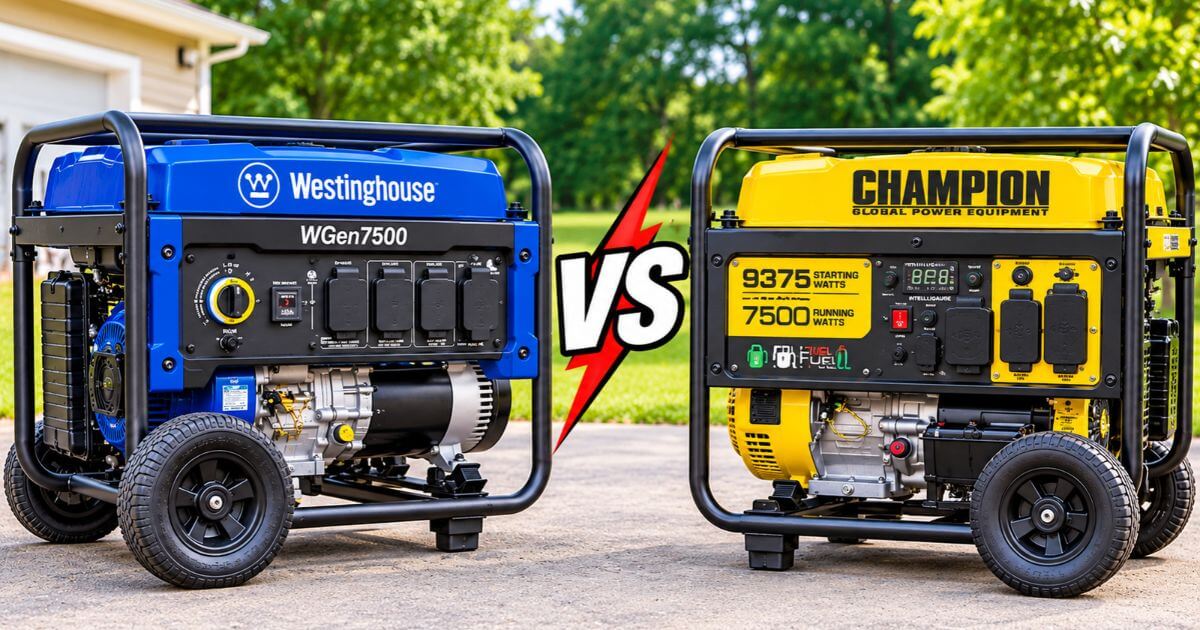
Westinghouse WGen7500 vs Champion 7500 Watt Generator: Which Is Better?
Choosing between the Westinghouse WGen7500 vs Champion 7500-watt generator is not just about comparing their power ratings. Both can supply substantial electricity for home backup, tools, and selected appliances, but they offer different features that may matter more depending on how you plan to use them.
The Westinghouse WGen7500 is a gasoline-powered portable generator with remote starting, a digital display, and a 6.6-gallon fuel tank. The Champion 100891 adds something the standard Westinghouse WGen7500 does not offer: the ability to run on either gasoline or propane.
Both generators deliver 7,500 running watts on gasoline and support 120V/240V output. However, the Champion offers slightly less peak power, while the Westinghouse has a remote-start feature and a lower published noise rating.
In this comparison, we examine their specifications, home-backup capabilities, fuel options, runtime, outlets, noise, portability, and safety features. The goal is to help you choose the generator that best fits your household, budget, and power requirements.
How We Compared These Generators
This comparison uses manufacturer-published specifications and product documentation for the Westinghouse WGen7500 and Champion 100891. We did not physically test either generator.
We compared their rated and starting power, fuel options, tank capacity, published runtime conditions, starting systems, outlet configurations, weight, noise ratings, and listed safety features. Where manufacturers use different measurement conditions, such as different loads for runtime figures, we identify the difference instead of declaring an unsupported winner.
Prices, availability, warranty terms, and product specifications can change. Before ordering, check the current product listing and confirm the exact model number.
Westinghouse WGen7500 Pros
Westinghouse WGen7500 Cons
- 7,500 running watts on gasoline.
- 9,500 peak watts.
- Remote, electric, and recoil starting.
- VFT display for voltage, frequency, and lifetime hours.
- 120V/240V output for compatible appliances and transfer equipment.
- Slightly lighter than the Champion 100891.
- Lower published noise rating.
- Standard model runs on gasoline only.
- No CO sensor is listed for this model.
- Not an inverter generator.
- Published runtime cannot be directly compared with Champion’s 50%-load figures.
- Heavy for frequent transport.
Champion 7500 watt generator Pros
Champion 7500 watt generator Cons
- 7,500 running watts on gasoline.
- Gasoline and propane operation.
- 120V and 120/240V outlet options.
- Electric and recoil starting.
- Includes CO Shield.
- Larger gasoline tank than the Westinghouse WGen7500.
- Additional 120V locking outlet.
- Lower rated output on propane.
- No remote start listed for this model.
- Slightly heavier than the Westinghouse.
- Higher published noise rating.
- Not an inverter generator.
1. Power Output: Which Generator Produces More Power?
Both generators provide 7,500 running watts on gasoline, making their continuous power capacity essentially equal.
The Westinghouse WGen7500 produces 9,500 peak watts, while the Champion 100891 produces 9,375 starting watts. The difference is only 125 watts, so peak output alone is unlikely to be the deciding factor for most buyers.
Starting watts matter when equipment draws extra power during startup. Refrigerators, well pumps, compressors, and air conditioners may need more power to start than they use once running. The actual starting requirement depends on the appliance.
The Champion also has a propane rating. It supplies 6,750 running watts and 8,400 starting watts when operating on propane. The Westinghouse WGen7500 runs on gasoline only, so it has no propane output rating.
For buyers who primarily need gasoline power, neither generator has a major advantage in rated running watts. If you plan to use propane, however, the Champion is the clear choice between these two exact models.
Power winner: Tie for gasoline running watts. The Westinghouse has a small peak-wattage advantage, while the Champion offers an additional fuel option.
2. Home Backup: Which Is Better for Power Outages?
For homeowners preparing for an outage, both generators offer 120V/240V output and 7,500 running watts on gasoline. That capacity can support a useful selection of essential household equipment when the total load remains within the generator’s limits.
Depending on their power requirements, possible loads include a refrigerator, lights, fans, selected kitchen appliances, a sump pump, or certain well pumps. You must calculate the running watts and starting requirements of the equipment you want to operate.
Neither model should be assumed to power every appliance in a house simultaneously. Electric water heaters, electric ranges, central air conditioners, and other high-demand appliances can use a large portion of the available output.
The Westinghouse WGen7500 has a 120/240V L14-30R outlet intended for compatible transfer-switch connections. The Champion 100891 also has a 120/240V L14-30R outlet, plus a separate 120V L5-30R locking outlet.
Both can be considered for planned home backup, but the right choice depends on the appliances you need to run and the connection system installed at your home.
A qualified electrician should install the appropriate transfer switch or approved connection equipment. Never connect a generator directly to a household wall outlet to energize home wiring.
Home-backup winner: Tie on basic power capacity. The Champion offers propane flexibility, while the Westinghouse offers remote starting.
3. Fuel Options: Gasoline vs Dual Fuel
Fuel flexibility is one of the biggest differences between these generators.
Westinghouse WGen7500
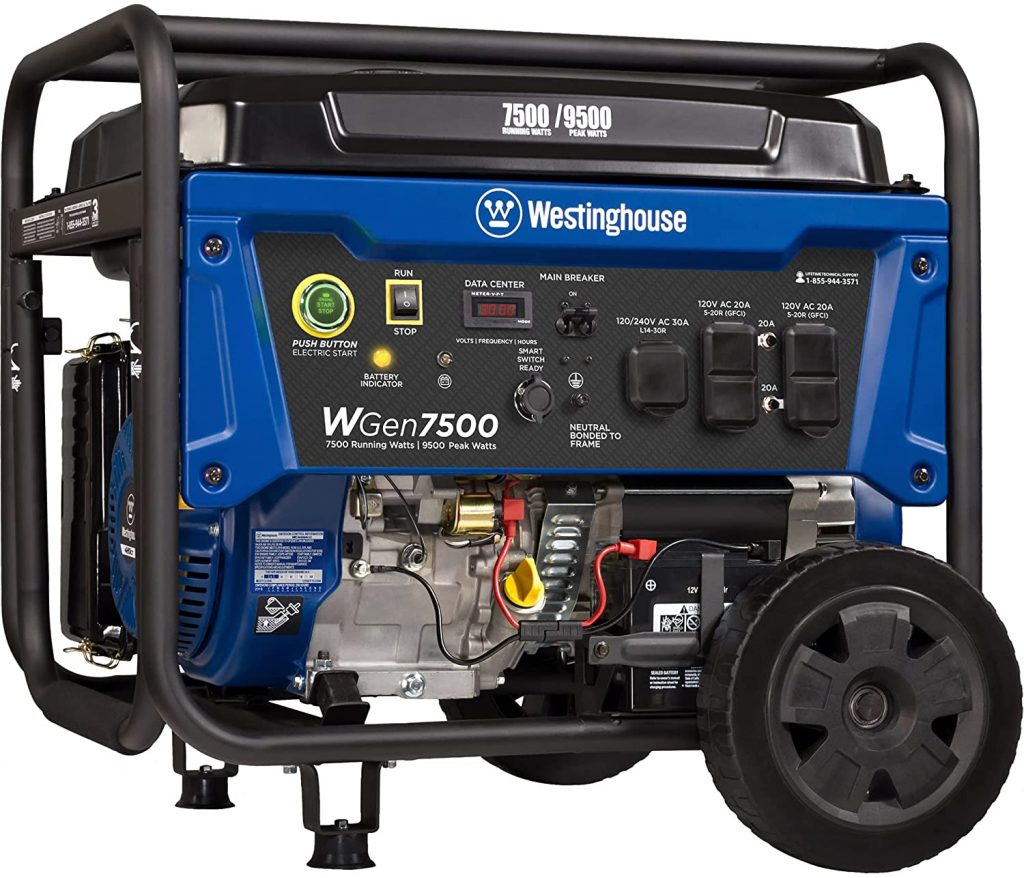
The standard WGen7500 runs on gasoline. Its 6.6-gallon tank and 7,500 running watts make it suitable for users who prefer a straightforward gasoline-powered setup.
Gasoline is widely available in many areas, but you need a safe plan for obtaining and storing fuel during an extended outage. Follow the manufacturer’s storage instructions and local rules.
This model is not the right choice if you specifically want to operate a generator using propane.
Champion 100891

The Champion 100891 can run on gasoline or propane. On gasoline, it produces 7,500 running watts. On propane, its rated output drops to 6,750 running watts.
That lower propane output is important. If your household load is close to the generator’s maximum gasoline capacity, you may need to disconnect some appliances when switching to propane.
Propane may appeal to homeowners who already use approved propane cylinders or want another fuel option for emergencies. You still need compatible equipment, correct handling, and suitable cylinder storage.
Fuel-flexibility winner: Champion 100891. It gives buyers two fuel options instead of one.
4. Runtime and Fuel Capacity
The Westinghouse WGen7500 has a 6.6-gallon gasoline tank. Its manufacturer lists up to 11 hours of runtime at 25% load.
The Champion 7500 watt generator has a larger 7.7-gallon gasoline tank. Champion lists up to 10 hours at 50% load on gasoline and up to 5.5 hours at 50% load on propane.
These numbers do not prove that one generator runs longer than the other. The Westinghouse figure is measured at 25% load, while the Champion’s published gasoline figure is at 50% load. A generator operating at a lower load will generally consume fuel more slowly.
For a fair comparison, you would need runtime measurements at the same load and under comparable conditions. We have not physically tested either generator, so we cannot claim a verified runtime winner.
If you need a generator for long outages, consider the number of hours you expect to operate it, the appliances you will connect, and how much fuel you can safely store. Advertised maximum runtime should not be treated as a guaranteed result.
Runtime winner: No clear winner from the published figures alone. The Westinghouse’s 25%-load figure and the Champion’s 50%-load figure are not directly comparable.
5. Starting System: Remote Start or Dual Starting Options?
The Westinghouse WGen7500 offers electric start, remote start, and recoil start. Its included wireless remote allows you to start the generator without standing beside the control panel, within the remote’s operating range and under suitable conditions.
This can be convenient when the generator is positioned in a safe outdoor location and you want to start it without walking to the machine. Remote starting does not make the generator an automatic standby system, and it must still be operated according to the manual.
The Champion 100891 has electric and recoil starting. Electric start is convenient for routine use, while recoil starting provides another way to start the engine.
The Champion’s lack of remote starting may matter to buyers who expect to start their generator from a distance. For others, the electric starter may be enough.
Starting-system winner: Westinghouse WGen7500. It includes remote starting in addition to electric and recoil starting.
6. Control Panel and Outlets
Outlet selection matters because your appliances, extension cords, tools, and home-backup equipment must match the generator’s receptacles.
Westinghouse WGen7500 outlets
The standard WGen7500 includes:
- Two 120V 20A GFCI duplex outlets.
- One 120V/240V L14-30R locking outlet.
Its VFT data center displays voltage, frequency, and lifetime operating hours. This information helps users monitor the generator while it is running.
Champion 100891 outlets
The Champion 100891 includes:
- Two 120V 20A GFCI duplex outlets.
- One 120V 30A L5-30R locking outlet.
- One 120V/240V 30A L14-30R locking outlet.
The additional 120V locking outlet gives the Champion more outlet variety for compatible equipment.
Both generators provide GFCI household outlets, but outlet count alone does not determine which model is better for every buyer. Check the plug, voltage, amperage, and load requirements of your equipment before purchasing.
Outlet winner: Champion 100891 for outlet variety. The Westinghouse’s VFT display remains useful for monitoring operating information.
7. Noise Level: Which Generator Is Quieter?
Westinghouse lists the WGen7500 at 72 dBA, while Champion lists the 100891 at 74 dBA.
On paper, the Westinghouse has the lower published noise rating. However, actual noise depends on the load, distance, surroundings, and measurement conditions. These figures should not be treated as a guarantee of the sound level at your home.
Neither generator is an enclosed inverter model designed primarily for quiet operation. Both may be noticeable to household members and neighbors.
If you live in a densely populated area or need power near sleeping areas, check local noise restrictions and consider a quieter inverter generator. Never operate a generator inside a garage, shed, house, or other enclosed or partially enclosed space to reduce noise.
Noise winner on published ratings: Westinghouse WGen7500. The two-decibel difference should not be treated as a guarantee of a noticeable difference in every setting.
8. Engine Size, Weight, and Portability
The Westinghouse WGen7500 uses a 420cc four-stroke OHV engine and weighs approximately 196 pounds.
The Champion 100891 uses a 439cc four-stroke engine and weighs approximately 205 pounds.
The Champion has the larger engine displacement, but that does not automatically mean it is more powerful in every respect. Both deliver the same 7,500 running watts on gasoline.
The Westinghouse is approximately nine pounds lighter. Both models have wheels and handles to help with movement, but neither is lightweight. Loading either unit into a vehicle or moving it over stairs may require assistance or suitable equipment.
For homeowners who plan to keep a generator in one location and move it only occasionally, the weight may be manageable. For camping, frequent transport, or small storage areas, a compact inverter generator may be a more practical option.
Portability winner: Westinghouse WGen7500, by listed weight. The difference is modest, and both are heavy portable generators.
9. Safety Features and Sensitive Electronics
Safety deserves attention when comparing any portable generator.
The Westinghouse WGen7500 lists automatic low-oil shutdown, automatic voltage regulation, overload protection, and GFCI outlets. Its standard product specification does not list a carbon monoxide sensor.
The Champion 100891 includes low-oil shutdown, automatic voltage regulation, GFCI outlets, and Champion’s CO Shield carbon monoxide shutdown system.
CO Shield is an additional safety feature, but it does not make indoor operation safe. Both generators must be operated outdoors, far from doors, windows, vents, and other openings. Follow the manual’s placement and operating instructions, and install working carbon monoxide alarms in your home.
Neither generator is an inverter generator. The Westinghouse WGen7500 lists total harmonic distortion of up to 23%. Buyers with sensitive electronic equipment should check the equipment manufacturer’s power-quality requirements and compare them with the generator’s published specifications. Do not assume that a conventional generator is suitable for every electronic device simply because it has voltage regulation.
Safety-feature advantage: Champion 100891 for its listed CO Shield system. This is a feature comparison, not a guarantee that either generator is safe in every operating situation.
10. Which Generator Is Better for Your Needs?
| Buyer type | Better fit | Why |
| Homeowner using gasoline only | Either | Both provide 7,500 running watts |
| Buyer who wants propane | Champion 100891 | Supports gasoline and propane |
| Buyer who values remote starting | Westinghouse WGen7500 | Includes a wireless remote |
| Buyer who wants more outlet variety | Champion 100891 | Adds a 120V L5-30R outlet |
| Buyer who prefers the lower listed weight | Westinghouse WGen7500 | Approximately 196 lb versus 205 lb |
| Buyer who prioritizes a listed CO shutdown feature | Champion 100891 | Includes CO Shield |
| Buyer who needs inverter technology | Neither | Both are conventional generators |
| Buyer who needs an RV-ready generator | Check another model or verify compatibility | The standard Westinghouse model is listed as not RV-ready; compatibility depends on the exact connections and requirements |
Final Verdict: Westinghouse WGen7500 vs Champion 7500 Watt Generator
The Westinghouse WGen7500 and Champion 100891 are both substantial portable generators for buyers who need 7,500 running watts on gasoline. Their core gasoline power capacity is equal, so the best choice depends more on fuel preferences, starting convenience, outlet needs, and safety features than on running watts.
Choose the Westinghouse WGen7500 if you plan to use gasoline, want remote starting, prefer its VFT display, and value its slightly lower weight and lower published noise rating.
Choose the Champion 100891 if you want the flexibility to switch between gasoline and propane, need its additional 120V locking outlet, or prefer a model with the listed CO Shield feature. Remember that it produces less power on propane than on gasoline.
Neither is the right choice if you specifically need inverter technology or a lightweight, quiet generator for frequent travel.
Our recommendation: For buyers who want fuel flexibility for emergency preparedness, the Champion 100891 is the more versatile choice. For buyers who will use gasoline and value remote starting, the Westinghouse WGen7500 may be the better fit. Check your appliance loads and exact model specifications before making the final decision.
Frequently Asked Questions
Is the Westinghouse WGen7500 better than the Champion 7500 watt generator?
Neither is better for everyone. Both produce 7,500 running watts on gasoline. The Westinghouse offers remote starting and a digital display, while the Champion 100891 offers gasoline and propane operation and CO Shield.
Does the Westinghouse WGen7500 run on propane?
The standard WGen7500 is gasoline-only. Do not confuse it with the WGen7500DF or WGen7500DFc, which are different dual-fuel models.
How many running watts does the Champion 100891 produce on propane?
It produces 6,750 running watts and 8,400 starting watts on propane. Its gasoline ratings are 7,500 running watts and 9,375 starting watts.
Which generator has the longer runtime?
The published figures do not provide a fair direct comparison. Westinghouse lists up to 11 hours at 25% load, while Champion lists up to 10 hours at 50% gasoline load. How long it runs will vary with the connected appliances and how the generator is used.
Can either generator power a whole house?
Either may power selected household circuits if their combined running and starting demands remain within the generator’s limits. Neither should be assumed to power every household appliance simultaneously. A qualified electrician should install the proper connection equipment.
Which generator is quieter?
Westinghouse lists the WGen7500 at 72 dBA and Champion lists the 100891 at 74 dBA. Actual sound levels vary with operating conditions and distance.
Are these inverter generators?
No. Both are conventional portable generators. Buyers who need inverter technology should compare suitable inverter models and check their power-quality specifications.
Which is better for sensitive electronics?
Neither should automatically be considered suitable for all sensitive electronics. The Westinghouse WGen7500 lists THD of up to 23%, and buyers should verify the power-quality requirements of their devices before connecting them. Check the relevant manufacturer documentation for the Champion model as well.
Does the Champion 100891 have remote start?
The published specifications list electric and recoil starting, not remote starting. The Westinghouse WGen7500 includes remote, electric, and recoil starting.
What should I check before buying?
Confirm the model number, required running and starting watts, fuel type, outlet compatibility, noise requirements, warranty terms, and whether the generator can safely connect to the equipment you intend to power.