ERAYAK 4500W vs Cummins Onan P4500i: Which Inverter Generator Is Better?
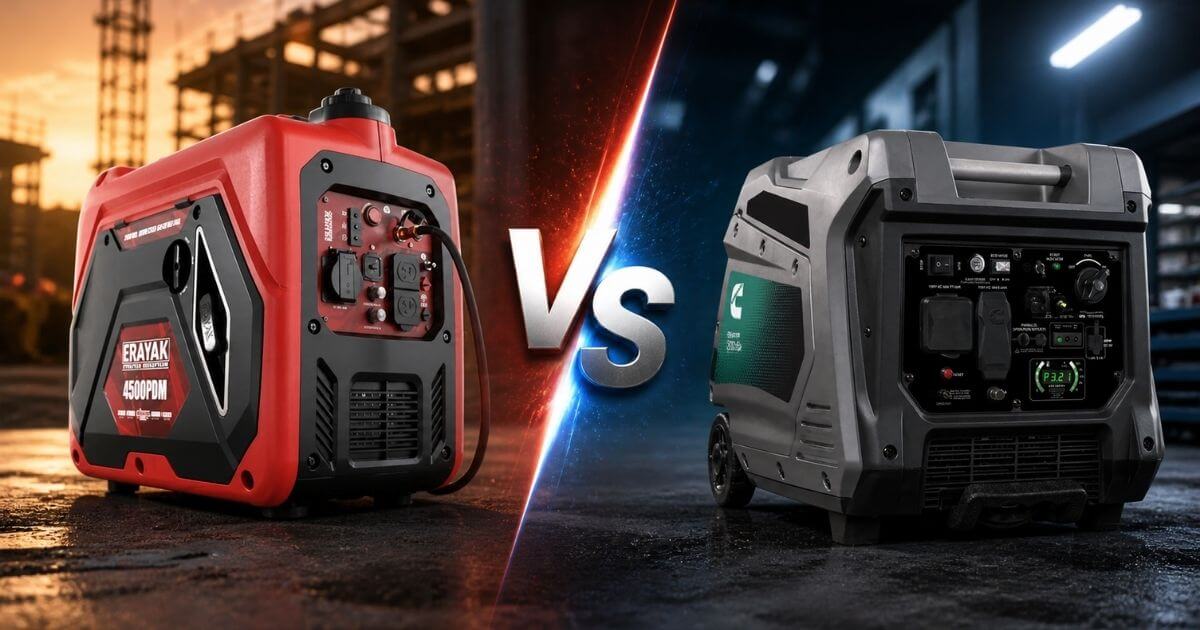
If you’re comparing the ERAYAK 4500W vs Cummins Onan P4500i, both generators offer enough power for RVs, camping, emergency backup, and everyday portable use.
On paper, they look similar because both produce 4,500 peak watts. But their designs are quite different.
The ERAYAK focuses on portability, fuel flexibility, and value. The Cummins Onan P4500i focuses on higher continuous output, longer gasoline runtime, quiet operation, and convenience features.
The biggest difference is weight. The ERAYAK weighs around 55 pounds, while the Cummins is close to 98 pounds. On the other hand, the Cummins provides 3,700 running watts, compared with 3,500 watts from the ERAYAK.
So which one is right for you?
Let’s compare them feature by feature.
Which One Should You Buy?
The answer depends on what matters most to you.
Choose the ERAYAK 4500W if:
- Portability is important.
- You want gasoline and propane options.
- You frequently move the generator.
- You’re mainly camping or RVing.
- You want strong value.
- 3,500 running watts is enough for your needs.
Choose the Cummins Onan P4500i if:
- You want 3,700 running watts.
- Quiet operation is important.
- You want remote start.
- You want a larger fuel tank.
- You prefer a more advanced display.
- You value established manufacturer support.
- You don’t mind the extra weight.
How We Compared Them
We compared the ERAYAK 4500W vs Cummins Onan P4500i based on power output, fuel flexibility, runtime, noise, portability, RV compatibility, starting options, power quality, features, maintenance, warranty, and overall value. Technical specifications were based primarily on manufacturer information, while our recommendations focus on how those differences affect everyday use.
ERAYAK 4500W Pros
ERAYAK 4500W Cons
- Lightweight
- Gasoline and propane operation
- 4,500 peak watts
- 3,500 running watts
- Low published THD
- 30A RV outlet
- Electric start
- Compact design
- Easy to transport
- 3-year warranty
- Lower running output than Cummins
- Smaller fuel tank
- Smaller engine
- Higher published noise level
- No comparable remote-start advantage
Cummins Onan P4500i Pros
Cummins Onan P4500i Cons
- 4,500 peak watts
- 3,700 running watts
- Larger 224cc engine
- 3.4-gallon fuel tank
- Quiet operation
- Remote start
- Electric start
- Recoil backup
- LED data display
- 30A RV outlet
- Parallel capability
- 3-year residential warranty
- Strong manufacturer reputation
- Nearly 100 pounds
- Gasoline-only
- Difficult to lift
- More expensive than many budget alternatives
- Not designed for whole-house backup
Power and Performance
The first major difference is continuous power.
The ERAYAK produces 4,500 peak watts and 3,500 running watts.
The Cummins produces 4,500 peak watts and 3,700 running watts.
Both provide the same maximum starting output, but the Cummins gives you an additional 200 watts for continuous loads.
That extra capacity can be useful when you’re running several appliances at once.
For example, you could potentially run a refrigerator, lights, television, internet equipment, and other smaller appliances while still having some power available for another moderate load.
However, you should always calculate your actual appliance wattage before connecting multiple high-demand devices.
Starting Power
Both generators provide 4,500 peak watts.
This is important for appliances with electric motors because they can require significantly more power when starting than when running.
Common examples include:
- Refrigerators
- Freezers
- Pumps
- Compressors
- RV air conditioners
- Power tools
Neither generator has an advantage in peak output.
The Cummins simply has more capacity for continuous loads.
Winner: Cummins Onan P4500i
Power Rating
- ERAYAK: 9/10
- Cummins: 9.5/10
Engine Comparison
The engine designs are quite different.
The ERAYAK uses a 143cc engine, while the Cummins Onan P4500i uses a larger 224cc OHV engine.
The larger Cummins engine helps support its higher continuous output.
It also contributes to the generator’s heavier weight.
The smaller ERAYAK engine allows the manufacturer to keep the overall generator much lighter.
This creates an interesting trade-off:
ERAYAK: smaller and easier to transport.
Cummins: larger engine and greater continuous power.
Winner: Cummins
For sustained power and engine capacity, the Cummins has the advantage.
Fuel Type, Tank Size and Runtime
Fuel flexibility is one of the ERAYAK’s strongest features.
The ERAYAK 4500W Tri-Fuel inverter generator is designed to operate on gasoline or propane, giving users two fuel options.
The standard Cummins Onan P4500i is gasoline-only.
For emergency preparedness, propane can be useful because it gives you an alternative fuel source when gasoline is difficult to obtain.
The Cummins counters with a larger fuel tank.
Fuel Capacity
ERAYAK: 2.25 gallons
Cummins: 3.4 gallons
The ERAYAK is rated for up to approximately 8 hours at 50% load.
The Cummins is advertised for extended operation at lighter loads, with published figures reaching up to approximately 18 hours at 25% load.
These numbers should not be compared directly because they use different load levels.
Runtime will also change depending on:
- Electrical load
- Fuel type
- Eco mode
- Temperature
- Generator condition
- Maintenance
Which Has Better Fuel Flexibility?
ERAYAK.
Which Has Better Gasoline Runtime?
Cummins.
This is one area where both generators have a clear advantage in different ways.
Noise Level
Noise is important when using a generator around an RV, campsite, or home.
The ERAYAK has a published noise rating of approximately 60.5 dB at 7 meters.
The Cummins Onan P4500i is rated as low as approximately 52 dBA under specified conditions.
Actual noise will vary with load and operating conditions, so these figures shouldn’t be treated as exact real-world noise levels in every situation.
Still, the Cummins has the stronger published noise specification.
Winner: Cummins Onan P4500i
Noise Rating
- ERAYAK: 8/10
- Cummins: 9.5/10
Design and Portability
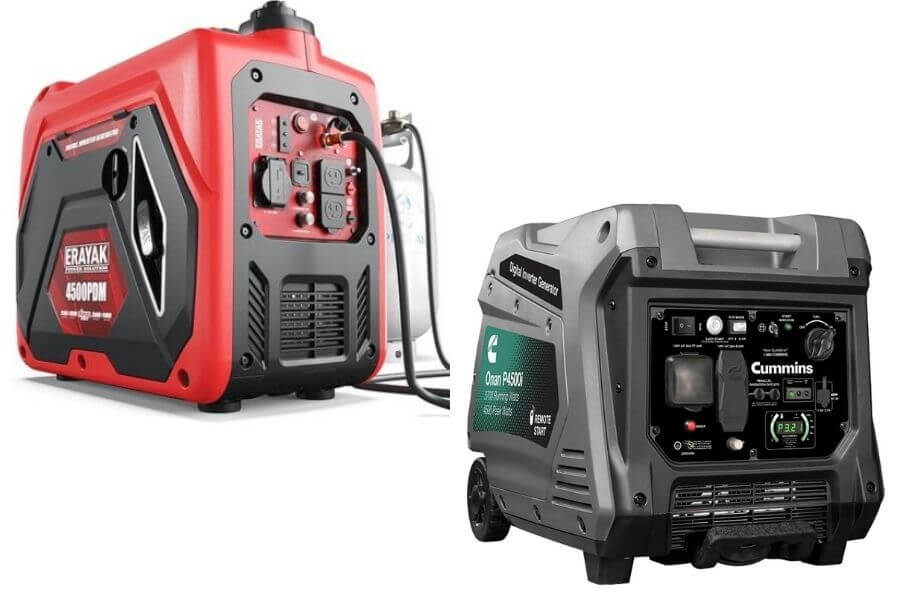
This is probably the biggest advantage of the ERAYAK tri fuel generator.
The ERAYAK weighs approximately 55 pounds.
The Cummins weighs approximately 98 pounds.
That’s a difference of more than 40 pounds.
For a generator that you frequently load into a truck, move around a campsite, or take in and out of storage, that difference is significant.
The Cummins does include wheels and a telescoping handle, so you can roll it across suitable surfaces.
However, there will still be situations where you need to lift it.
The ERAYAK is much easier for one person to handle.
Winner: ERAYAK
Portability Rating
- ERAYAK: 9.5/10
- Cummins: 8/10
RV Compatibility
Both generators are well suited to RV use because they provide a 30-amp RV connection.
The ERAYAK’s lower weight makes it easier to transport.
The Cummins offers some additional advantages for RV owners, including:
- Higher continuous output
- Remote start
- Larger fuel tank
- Lower published noise level
For an RV owner who frequently moves the generator, ERAYAK’s weight can be more important.
For someone who keeps the generator outside the RV and wants maximum convenience, the Cummins makes more sense.
Winner: Cummins Onan P4500i
The Cummins offers the more complete RV package, while the ERAYAK is the easier generator to transport.
Starting System
Starting convenience is another area where the Cummins stands out.
The P4500i offers:
- Electric start
- Remote start
- Recoil backup
Remote start is particularly useful for RV owners because the generator can be started without walking outside.
The ERAYAK also offers electric starting and recoil starting, depending on the exact version.
However, it doesn’t offer the same overall remote-start convenience as the Cummins.
Winner: Cummins
Starting Rating
- ERAYAK: 8.5/10
- Cummins: 9.5/10
Outlets and Control Panel
Both generators provide the connections needed for common portable applications.
The ERAYAK includes a 30A RV connection, household outlets, USB charging, and generator monitoring functions.
The Cummins also includes a 30A RV outlet, household outlets, USB ports, and an LED information display.
The Cummins display is particularly useful because it can provide information such as:
- Fuel level
- Voltage
- Power output
- Runtime
- Operating hours
This gives you more information about how the generator is performing.
Winner: Cummins
The P4500i’s display and control system feel more complete.
Power Quality
Both models use inverter technology.
This makes them suitable for many sensitive electronic devices, including:
- Computers
- TVs
- Laptops
- Smartphones
- Routers
- Battery chargers
The ERAYAK publishes a lower THD figure than the Cummins. Read about THD in Generators: Why It Matters for Electronics.
However, both are designed to provide clean inverter power.
For most users, there isn’t likely to be a meaningful difference in everyday use.
Winner: ERAYAK
Based on the published specifications, the ERAYAK has the advantage for THD.
Power Quality Rating
- ERAYAK: 9.5/10
- Cummins: 9/10
What Can They Run?
Both generators can handle many common appliances.
| Appliance | Approximate Running Watts |
| Refrigerator | 100–400W |
| Freezer | 100–400W |
| LED Lights | 50–200W |
| Television | 50–200W |
| Wi-Fi Router | 10–30W |
| Laptop | 50–100W |
| Microwave | 800–1,500W |
| Coffee Maker | 600–1,500W |
| Fan | 30–100W |
| Battery Charger | 50–300W |
Actual power consumption varies by appliance.
The Cummins’ extra 200 running watts gives it slightly more headroom when several appliances are operating together.
Neither generator should be expected to power an entire large home with multiple high-demand appliances at the same time.
RV Air Conditioner Performance
RV air conditioners deserve special attention.
They can require significant startup power, even when their normal running consumption is much lower.
Both generators provide 4,500 peak watts, so either can potentially operate a compatible RV air conditioner.
However, the Cummins has a small advantage because it provides 3,700 running watts compared with 3,500 watts from the ERAYAK.
Your actual air conditioner determines whether either generator will work.
Check its running and starting wattage before buying.
A soft-start device can also reduce startup demand on some RV air conditioners.
Winner: Cummins
Safety Features
Both generators include common protection systems such as:
- Low-oil shutdown
- Overload protection
- Circuit protection
- Engine protection
But generator safety goes beyond the built-in features.
Never operate either generator:
- Inside a house
- Inside a garage
- Inside an RV
- In a basement
- In an enclosed shed
Portable generators produce carbon monoxide.
Always operate them outdoors and follow the manufacturer’s recommended clearance requirements.
Winner: Tie
Both offer the basic safety protections expected from modern portable inverter generators.
Maintenance and Reliability
Both generators require regular maintenance.
Important tasks include:
- Checking engine oil
- Changing oil
- Cleaning or replacing the air filter
- Checking the spark plug
- Maintaining the fuel system
- Preparing the generator for storage
The smaller ERAYAK engine helps keep the machine lightweight, while the Cummins uses a larger engine designed to provide more continuous power.
For either generator, proper maintenance will have a major effect on long-term reliability.
Fuel storage is especially important for gasoline-powered equipment.
If you plan to store the generator for an extended period, follow the manufacturer’s fuel-storage procedure.
Winner: Tie
Both require routine maintenance and proper storage.
Warranty and Brand Support
The ERAYAK comes with a 3-year consumer warranty.
The Cummins Onan P4500i offers a 3-year residential warranty, with different coverage for commercial use.
Warranty length is similar, but Cummins has a major advantage in brand history and established power-equipment support.
For buyers who plan to keep their generator for many years, access to parts, documentation, and service can be important.
Winner: Cummins
Price and Overall Value
Generator prices change, so the best way to compare value is by looking at what each model offers.
The ERAYAK is attractive because it combines:
- Low weight
- Dual-fuel operation
- Good power output
- RV compatibility
- Compact design
The Cummins costs more in many markets but provides additional features such as:
- Higher running output
- Larger engine
- Larger fuel tank
- Remote start
- Quiet operation
- Detailed display
- Strong brand support
Best Value: ERAYAK
If your needs are straightforward and you don’t need the extra convenience features, the ERAYAK offers strong value.
Best Premium Choice: Cummins
If you want more power and convenience and don’t mind the extra weight, the Cummins is worth considering.
Final Verdict
The Cummins Onan P4500i wins this comparison by a small margin.
Its biggest strengths are the higher continuous output, larger engine, larger fuel tank, quieter operation, remote start, detailed display, and strong manufacturer support.
It is particularly well suited to RV owners and homeowners who want a premium portable generator with plenty of useful features.
The ERAYAK 4500W takes a different approach.
Its biggest advantages are its much lower weight and dual-fuel capability.
At around 55 pounds, it is dramatically easier to transport. If you regularly move your generator or want propane as an alternative fuel, the ERAYAK becomes very attractive.
So the decision is simple:
Choose ERAYAK for portability, fuel flexibility, and value.
Choose Cummins for power, quiet operation, convenience, and long-term ownership confidence.
For most users looking for the more complete overall package, I’d choose the Cummins Onan P4500i.
For buyers who prioritize portability above everything else, the ERAYAK 4500W may actually be the better generator.
Final Recommendation
The Cummins Onan P4500i is the better all-around generator, while the ERAYAK 4500W is the better lightweight and fuel-flexible option.
Frequently Asked Questions
Is the ERAYAK 4500W better than the Cummins P4500i?
The ERAYAK is better for portability and fuel flexibility. The Cummins is better for continuous power, quiet operation, runtime, and convenience.
Which generator produces more power?
The Cummins produces 3,700 running watts, while the ERAYAK produces 3,500 running watts. Both have 4,500 peak watts.
Which generator is lighter?
The ERAYAK is approximately 55 pounds, while the Cummins is approximately 98 pounds.
Which is quieter?
The Cummins Onan P4500i has the better published noise rating.
Which is better for an RV?
Both are suitable, but the Cummins is better if you prioritize power and convenience. The ERAYAK is better if weight and fuel flexibility are more important.
Is the ERAYAK 4500W dual-fuel?
Yes, the current version is generally marketed for gasoline and propane operation. Always check the exact model before purchasing.
Is the Cummins P4500i dual-fuel?
No. The standard P4500i is gasoline-only. Cummins offers the P4500iDF as a separate dual-fuel model.
Which is better for camping?
The ERAYAK is the better option if portability is your main concern.
Which is better for home backup?
The Cummins has a slight advantage because of its higher running output and larger fuel tank.
Can both run sensitive electronics?
Yes. Both use inverter technology and are designed to provide clean power for common electronic devices.
Can these two generators be connected together?
No. They should not be connected together. Parallel operation requires compatible generators and the correct parallel equipment.
Can either generator power an entire house?
No. These are portable generators intended for selected loads. A larger generator is needed for whole-house backup.