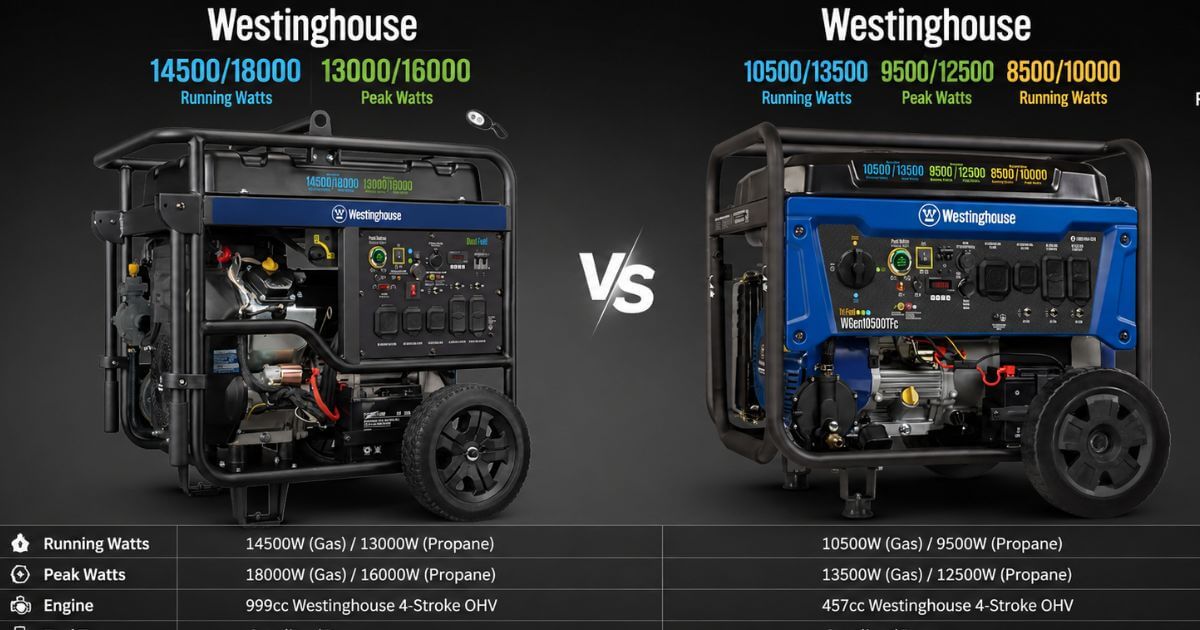
Westinghouse WGen14500DFC vs Westinghouse WGen10500TFc
Choosing between the Westinghouse WGen14500DFC and the Westinghouse WGen10500TFc isn’t as simple as picking the generator with the highest wattage. Both models are designed for serious backup power, but they solve different problems.
The WGen14500DFC prioritizes maximum output and cleaner electrical power, making it a strong option for homeowners with larger electrical demands. The WGen10500TFc, on the other hand, sacrifices some output to offer tri-fuel capability, allowing it to run on gasoline, propane, or natural gas.
So which one offers better value?
The answer depends on your home’s electrical requirements, the fuels available in your area, and how you plan to use the generator. In this comparison, we’ll go beyond the specification sheet and explain how these differences affect real-world performance, operating costs, and long-term ownership.
Which Generator Should You Buy?
Both generators are excellent choices, but they’re designed for different situations. Here’s a simple way to decide.
Choose the Westinghouse WGen14500DFC if you:
- Have a large home with high power demands.
- Want more reserve capacity for future electrical needs.
- Need to run several heavy appliances at the same time.
- Want lower published THD for many modern electronic devices.
- Prefer higher performance over additional fuel options.
For homeowners who need the highest output from a portable generator, the WGen14500DFC is the stronger option.
Choose the Westinghouse WGen10500TFc if you:
- Already have a natural gas connection at home.
- Want the flexibility to switch between three fuel types.
- Live in an area that experiences extended power outages.
- Prefer a generator that’s easier to move and store.
- Don’t need the extra power offered by the WGen14500DFC.
For many homeowners, the ability to use natural gas can be more valuable than having additional wattage that may never be used.
Who Should Skip These Generators?
Neither model is the right choice for every buyer.
You may want to consider a smaller inverter generator if you:
- Need a lightweight unit for camping or tailgating.
- Usually power only a refrigerator, lights, and a few small electronics.
- Want very quiet operation.
- Have limited storage space.
- Need maximum fuel efficiency for light electrical loads.
Large conventional generators are best suited for emergency home backup rather than recreational use.
Quick Verdict
If you simply need the most powerful portable generator, the Westinghouse WGen14500DFC is the stronger choice. Its larger engine, higher running wattage, and lower published Total Harmonic Distortion (THD) make it better suited for demanding household loads and many modern electronic devices.
However, if your home already has a natural gas connection, the Westinghouse WGen10500TFc offers a level of flexibility that the WGen14500DFC cannot match. During a long power outage, having access to a continuous fuel supply can be a significant advantage over relying solely on stored gasoline or propane.
Neither generator is objectively better in every situation. The right choice depends on what matters most to you: maximum power or maximum fuel flexibility.
Our Recommendation
🏆 Best for Maximum Backup Power
Westinghouse WGen14500DFC
Ideal for larger homes, higher electrical loads, and buyers who want extra performance and lower THD.
Overall Rating: 9.7/10
🏆 Best for Fuel Flexibility
Westinghouse WGen10500TFc
Ideal for homeowners with natural gas service who want the convenience of three fuel options without sacrificing dependable backup performance.
Overall Rating: 9.6/10
Westinghouse WGen14500DFC Pros & Cons
Westinghouse WGen10500TFc Pros & Cons
Pros
- Excellent power for demanding residential backup.
- Larger engine handles heavy startup loads with ease.
- Lower published THD than the WGen10500TFc.
- Strong choice for larger homes.
- Remote, electric, and recoil start included.
Cons
- Significantly heavier.
- Requires more storage space.
- Dual-fuel only.
- Higher fuel consumption under heavy loads.
Pros
- True tri-fuel capability.
- Natural gas option increases fuel flexibility.
- Easier to move and store.
- Remote start included.
- Well suited for most residential backup applications.
Cons
- Lower maximum output.
- Higher published THD than the WGen14500DFC.
- Less reserve capacity for very large electrical loads.
Build Quality Comparison
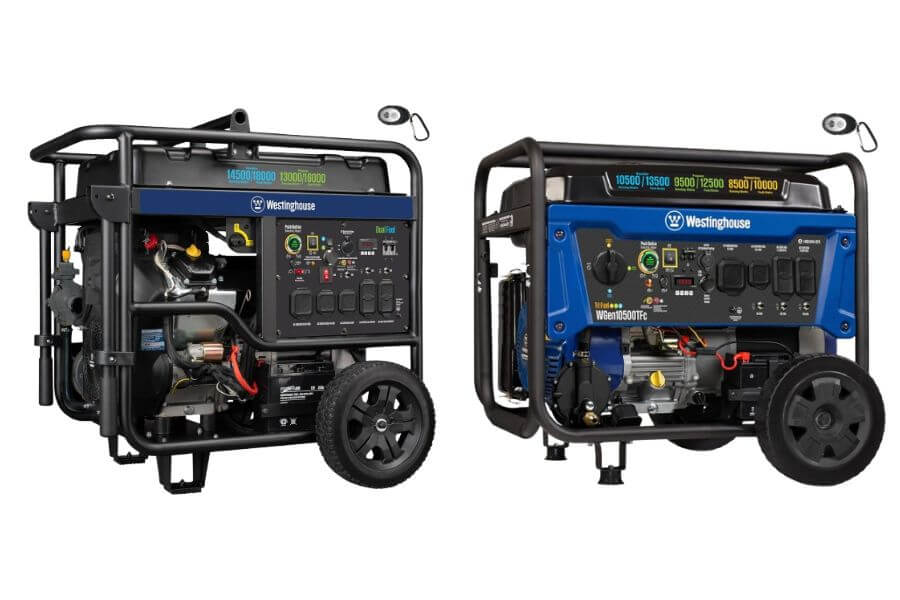
Both generators reflect Westinghouse’s focus on durability.
Each model features:
- Heavy-duty steel construction.
- Powder-coated frame.
- Large never-flat wheels.
- Folding handles.
- Durable engine components.
- Protective outlet covers.
The overall build quality is excellent on both models.
The main difference comes from size.
The WGen14500DFC is physically larger because of its more powerful engine and increased output.
The WGen10500TFc has a slightly smaller footprint, making it easier to store in most garages or sheds.
Neither generator feels cheaply built.
Winner: Tie
Portability Comparison
Neither of these generators is lightweight, but there is a noticeable difference.
| Generator | Approximate Weight |
| WGen14500DFC | 352 lbs |
| WGen10500TFc | 250 lbs |
A difference of around 100 pounds has a real impact when moving the generator.
Although both models include wheels and folding handles, the WGen10500TFc is generally easier to reposition around your property.
If you expect to move the generator frequently—for example, between storage and your backup power location—you’ll likely appreciate the lighter weight.
The WGen14500DFC is better treated as a generator that stays in a dedicated location until needed.
Winner: Westinghouse WGen10500TFc
Engine Performance: Does the Bigger Engine Make a Difference?
Both generators are built for demanding backup power, but they take different approaches to delivering it.
The WGen14500DFC uses a 713cc OHV V-Twin engine, while the WGen10500TFc is powered by a 500cc OHV engine.
A larger engine isn’t automatically better, but in this case it provides several practical advantages.
The V-Twin engine in the WGen14500DFC is designed to deliver more torque, which helps the generator handle heavy startup loads with less strain. Appliances such as central air conditioners, well pumps, and large air compressors often require significantly more power for a few seconds during startup than they do while running.
That extra engine capacity gives the WGen14500DFC a larger performance reserve when several demanding appliances start around the same time.
The WGen10500TFc still performs very well for residential backup power. However, because it has a smaller engine and lower maximum output, you’ll need to pay closer attention to your total electrical load during periods of heavy use.
Winner: Westinghouse WGen14500DFC
Why?
- Larger 713cc V-Twin engine.
- Better suited for heavy startup loads.
- More reserve power during peak demand.
Power Quality: Which Generator Is Better for Modern Electronics?
Power quality is often overlooked, but it can be important if you plan to operate televisions, desktop computers, networking equipment, gaming consoles, or similar electronics during an outage.
The WGen14500DFC has a published Total Harmonic Distortion (THD) of 5% or less, making it suitable for many modern electronic devices.
The WGen10500TFc has a published THD of up to 23%, which is typical of many conventional generators but considerably higher than the WGen14500DFC.
This does not mean the WGen10500TFc cannot power electronics. Many household devices will operate normally. However, equipment that requires particularly clean power should always be used according to the manufacturer’s recommendations, and additional power protection may be appropriate.
If clean electrical output is a priority, the WGen14500DFC has a clear advantage.
Winner: Westinghouse WGen14500DFC
Which Generator Is Better for Large Homes?
If your goal is to keep a large home operating during an outage, power output becomes one of the most important factors.
The WGen14500DFC has a clear advantage because it provides more running and starting watts. That additional capacity gives you greater flexibility when several high-demand appliances need to operate at the same time.
For example, a household using a central air conditioner, refrigerator, freezer, well pump, lighting circuits, and kitchen appliances places a much heavier demand on a generator than a smaller home powering only basic essentials.
With its higher output, the WGen14500DFC offers more room before reaching its maximum capacity. That doesn’t mean you’ll never need to manage electrical loads, but it reduces the likelihood of overloading the generator when multiple appliances start at once.
The WGen10500TFc still provides enough power for many medium to large homes, but homeowners with higher electrical demands may need to be more selective about which appliances operate simultaneously.
Winner: Westinghouse WGen14500DFC
Which Generator Is Better for Extended Power Outages?
Power isn’t the only consideration during an emergency. Fuel availability can become just as important after several days without electricity.
This is where the WGen10500TFc has a unique advantage.
If your home is connected to a reliable natural gas supply, you don’t need to refill gasoline cans or replace propane cylinders as frequently. As long as natural gas service remains available, you have access to a continuous fuel source.
The WGen14500DFC can still operate for long periods using gasoline or propane, but you’ll need to plan ahead by storing enough fuel safely.
For homeowners living in areas that experience hurricanes, ice storms, or other long-duration outages, natural gas capability may be a deciding factor.
Winner: Westinghouse WGen10500TFc
Real-World Appliance Performance
Looking only at wattage numbers doesn’t tell the whole story. Most homeowners simply want to know:
“What can each generator actually power?”
The answer depends on the total running load and the starting requirements of each appliance, but the comparison below provides a practical idea of their capabilities.
| Appliance | WGen14500DFC | WGen10500TFc |
| Refrigerator | ✅ | ✅ |
| Upright Freezer | ✅ | ✅ |
| Gas Furnace Blower | ✅ | ✅ |
| Sump Pump | ✅ | ✅ |
| Well Pump | ✅ | ✅ |
| Microwave | ✅ | ✅ |
| Dishwasher | ✅ | ✅ |
| Washing Machine | ✅ | ✅ |
| Window Air Conditioner | ✅ | ✅ |
| Electric Water Heater | ✅ | ⚠ May require load management |
| Electric Range (One Element) | ✅ | ⚠ Depends on total load |
| Central Air Conditioner | ✅ Better suited | ✅ Many systems |
| Garage Door Opener | ✅ | ✅ |
| LED Lighting | ✅ | ✅ |
| Internet Router | ✅ | ✅ |
The most noticeable difference appears when multiple high-demand appliances are running at the same time.
For example, imagine your home is operating:
- Central air conditioner
- Refrigerator
- Freezer
- Well pump
- Microwave
- Lights
- Television
- Internet router
Both generators can handle this type of workload in many homes, but the WGen14500DFC provides a larger safety margin before approaching its maximum rated capacity.
If your electrical demand increases unexpectedly, that additional reserve power becomes valuable.
Winner: Westinghouse WGen14500DFC
Which Generator Handles a Motor Starting Better?
Many household appliances don’t draw their highest power while running—they draw it when starting.
Examples include:
- Air conditioners
- Refrigerators
- Well pumps
- Air compressors
- Sump pumps
This brief surge is known as starting wattage.
The WGen14500DFC offers approximately 1,000 more starting watts on gasoline than the WGen10500TFc.
That difference may not seem dramatic on paper, but it can reduce the likelihood of overloads when several motor-driven appliances start within a short period.
For homeowners with larger HVAC systems or deep well pumps, the additional starting capacity provides extra confidence during outages.
Winner: Westinghouse WGen14500DFC
Fuel Efficiency & Runtime Comparison
Both generators are designed to operate for extended periods, but their runtime figures shouldn’t be compared without considering the load percentage.
| Generator | Fuel Tank | Advertised Runtime* |
| WGen14500DFC | 9.8 Gallons | Up to 19 hours at 25% load |
| WGen10500TFc | 9.5 Gallons | Up to 12 hours at 50% load |
*Manufacturer-claimed figures under specified test conditions.
Because these runtimes are measured at different load levels, they don’t provide a direct head-to-head comparison.
In practical use, runtime depends on factors such as:
- Total electrical demand.
- Fuel type.
- Ambient temperature.
- Altitude.
- Generator maintenance.
A lightly loaded generator generally consumes less fuel than one operating near its maximum capacity.
Which One Is More Economical?
If both generators are supplying similar electrical loads, the smaller WGen10500TFc may consume less fuel simply because it is producing less maximum power.
However, if your home consistently requires higher output, the WGen14500DFC may be the better choice because it can carry that load without operating as close to its limit.
Instead of asking which generator is more fuel efficient, it’s more useful to ask:
“Which generator is correctly sized for my home?”
Choosing a generator with significantly more capacity than you need—or one that’s too small—can reduce overall efficiency.
Winner: Tie
Both models offer good runtime for their size. The better choice depends on your home’s electrical demand rather than the advertised runtime alone.
Noise Comparison
Neither generator is designed for quiet recreational use.
Both are conventional open-frame generators built for delivering high output rather than minimizing sound.
At light electrical loads, engine noise is noticeable but typical for generators in this class.
As the electrical demand increases, both models become louder because the engine is working harder to produce power.
In practical terms:
- Both are suitable for emergency home backup.
- Neither is ideal for camping or tailgating.
- Local noise regulations may restrict operation in some residential areas.
If quiet operation is one of your highest priorities, an inverter generator is a better choice than either of these models.
Winner: Tie
Which Generator Is Easier to Own?
Choosing a generator isn’t only about performance. It’s also about how easy it is to live with over the next several years.
WGen14500DFC
Ownership is straightforward, but you’ll need to plan for:
- Gasoline or propane storage.
- Routine engine maintenance.
- More space because of its larger size.
- Moving a heavier machine.
The benefit is higher power when you need it.
WGen10500TFc
The WGen10500TFc offers one convenience that can make a big difference during emergencies:
Natural gas compatibility.
If your home already has a properly installed natural gas connection, you can avoid many of the fuel storage concerns associated with gasoline.
That convenience alone is a major reason some homeowners choose this model despite its lower maximum output.
Winner: Westinghouse WGen10500TFc
Maintenance Comparison
Routine maintenance is very similar for both generators.
To keep either model in good condition, you should:
- Check the engine oil before each use.
- Change the oil according to the owner’s manual.
- Clean or replace the air filter when needed.
- Inspect the spark plug periodically.
- Keep cooling vents free of dirt and debris.
- Test-run the generator every few months.
- Charge or maintain the electric-start battery during storage.
Neither generator requires unusually complicated maintenance.
The only additional consideration is the fuel system.
Because the WGen10500TFc can run on natural gas, homeowners who primarily use natural gas won’t have to worry as much about gasoline degrading during storage.
Winner: Westinghouse WGen10500TFc (Slight Advantage)
Parts Availability
Replacement parts are an important consideration, especially if you plan to keep your generator for many years.
Westinghouse offers replacement parts and customer support for both models, and common maintenance items such as:
- Air filters
- Spark plugs
- Oil filters (where applicable)
- Batteries
- Wheels
- Handles
are generally easier to obtain than specialized internal engine components.
Because both generators are current Westinghouse models, parts availability is similar.
Winner: Tie
Operating Costs
The purchase price is only part of the total cost of owning a generator.
Over several years, you’ll also spend money on:
- Fuel
- Engine oil
- Spark plugs
- Air filters
- Battery replacement
- Routine maintenance
The actual operating cost depends on how often you use the generator and how heavily it’s loaded.
WGen14500DFC
Pros:
- More power available.
- Less likely to operate near maximum capacity.
Cons:
- Higher fuel consumption when powering large loads.
WGen10500TFc
Pros:
- Natural gas may reduce refueling effort.
- Potentially lower fuel costs where natural gas is less expensive than gasoline or propane.
Cons:
- Lower power output on natural gas.
If your home already has natural gas service, operating costs during long outages may be lower than relying entirely on gasoline.
Winner: Westinghouse WGen10500TFc
Value for Money
Both generators provide strong value, but for different reasons.
The WGen14500DFC justifies its price by offering:
- Higher power output.
- Larger engine.
- Lower published THD.
- Greater capacity for demanding homes.
The WGen10500TFc focuses on flexibility rather than maximum output.
Its ability to run on three fuel types can be more valuable than additional wattage for many homeowners, particularly those who already have a natural gas connection.
Instead of asking, “Which generator costs less?”, ask:
“Which generator solves my backup power needs without paying for capacity I won’t use?”
That question usually leads to the better buying decision.
Value Winner
- Large homes with heavy electrical demand: 🏆 WGen14500DFC
- Average homes with natural gas service: 🏆 WGen10500TFc
Final Verdict
The Westinghouse WGen14500DFC and Westinghouse WGen10500TFc are among the strongest portable home backup generators in Westinghouse’s lineup, but they appeal to different types of buyers.
The WGen14500DFC stands out with its larger engine, higher power output, and lower published THD. If your priority is running more appliances simultaneously or supporting a larger home’s electrical demands, it’s the better choice.
The WGen10500TFc takes a different approach by offering tri-fuel capability. For homeowners with access to natural gas, that flexibility can make extended outages easier to manage without constantly refueling.
Rather than choosing the generator with the biggest numbers, choose the one that best matches your home’s electrical requirements and the fuels you can realistically access during an emergency.