Generator AVR Problems Explained: Symptoms, Causes, Testing & Fixes
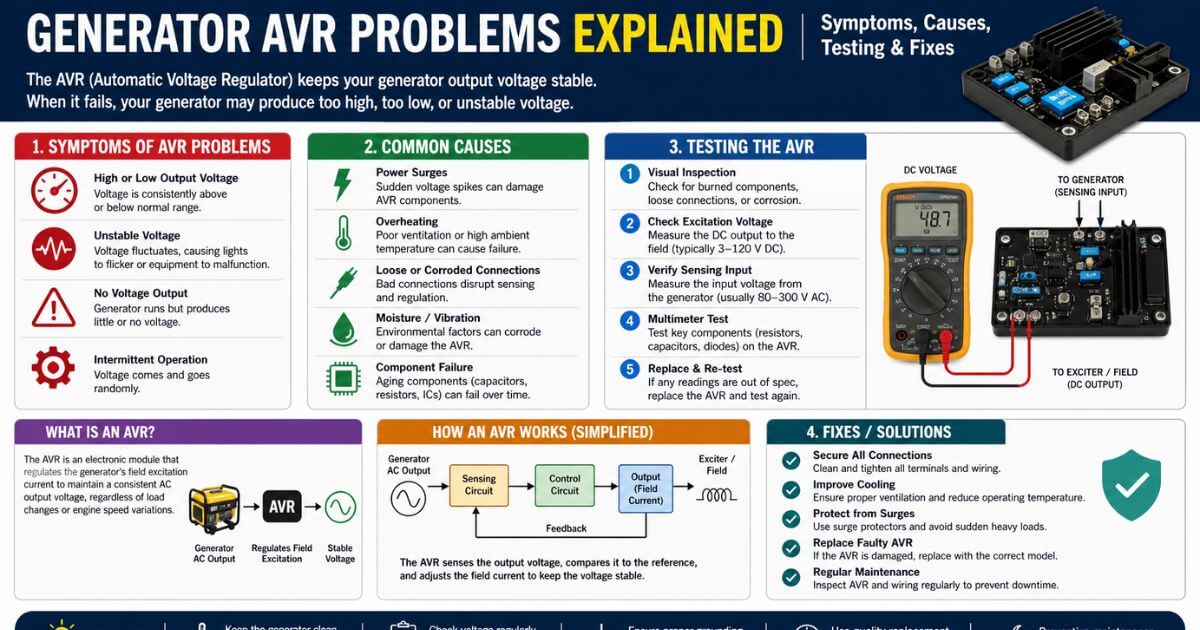
If your generator starts normally but produces low voltage, high voltage, or no power at all, a faulty Automatic Voltage Regulator (AVR) could be the cause.
The AVR is responsible for keeping the generator’s output voltage stable. When it fails, the engine may continue running, but the electricity becomes unreliable or stops completely.
However, not every voltage problem is caused by a bad AVR. Worn carbon brushes, loose wiring, engine speed issues, or damaged alternator components can produce similar symptoms.
This guide explains the most common AVR problems, how to identify the symptoms, test the AVR safely, and determine whether it needs to be repaired or replaced.
Key Takeaways
- Regular maintenance and avoiding overloads can help extend the life of the AVR.
- The AVR ensures your generator produces consistent voltage, even when the electrical load changes.
- Low voltage, high voltage, and no power are common signs of AVR-related problems.
- Don’t replace the AVR until you’ve checked the wiring, brushes, engine speed, and circuit breaker.
- Use a multimeter to measure the generator’s output before diagnosing the fault.
- Install only a compatible replacement AVR for your specific generator model.
How Does a Generator AVR Work?
Before looking for problems, it’s important to understand what the AVR actually does.
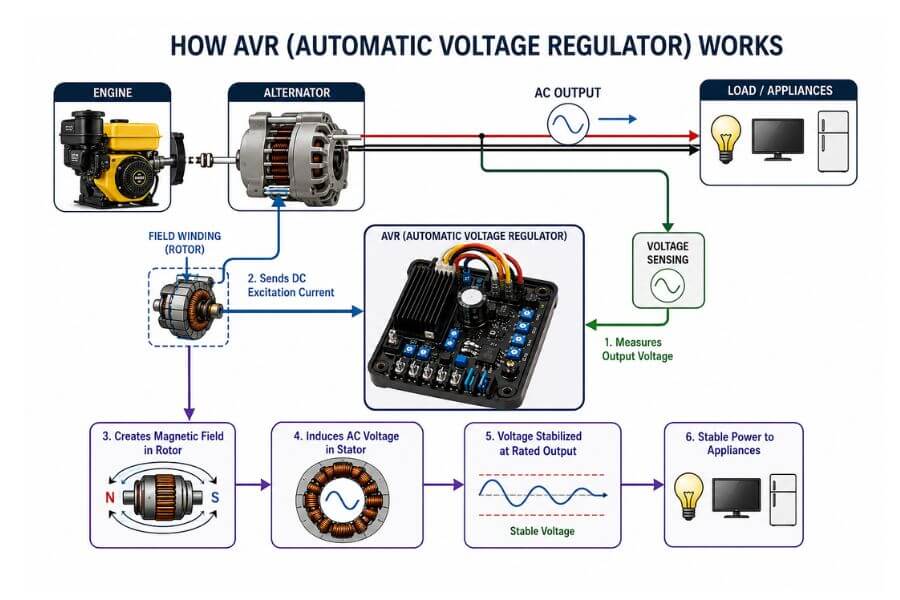
The Automatic Voltage Regulator (AVR) is an electronic component that keeps the generator’s output voltage stable.
Every time you plug in or disconnect an appliance, the electrical load changes. Without voltage regulation, the generator’s output would constantly rise and fall.
The AVR automatically adjusts the alternator’s magnetic field to keep the voltage close to its rated output.
For example, if you’re only running a few small appliances like LED lights or phone chargers, the generator doesn’t have to produce much power.
Now imagine someone plugs in a refrigerator or an air compressor.
The electrical demand suddenly increases.
Instead of allowing the voltage to drop sharply, the AVR responds almost instantly and helps maintain stable power.
This is why the AVR plays such an important role in protecting both the generator and the appliances connected to it.
Does Every Generator Have an AVR?
No.
This is one of the biggest misconceptions among generator owners.
Conventional Portable Generators
Most conventional portable generators use an AVR to regulate voltage.
These are the generators commonly used for:
- Home backup power
- Construction sites
- Farms
- Workshops
- Emergency power
If one of these generators develops voltage problems, the AVR is one of the components that should be inspected.
Inverter Generators
Inverter generators work differently.
Instead of using a traditional AVR, they use an inverter control module to produce stable electricity.
If an inverter generator isn’t producing power, the fault is usually related to the inverter system rather than a conventional AVR.
Knowing the difference can save you from buying the wrong replacement part.
Common Signs of a Bad Generator AVR
A faulty AVR doesn’t always produce the same symptoms.
Sometimes the generator produces no electricity at all.
Other times, the voltage becomes unstable or incorrect.
Below are the most common warning signs.
Generator Runs but Produces No Power
This is probably the most common complaint.
The engine starts normally.
It idles smoothly.
Everything sounds fine.
But when you plug in an appliance, it doesn’t receive any power.
Before blaming the AVR, check these simple things first:
- Reset the generator’s circuit breaker.
- Make sure the outlet isn’t damaged.
- Confirm the appliance works on another power source.
If those checks don’t solve the problem, the AVR becomes one of the likely causes. Also read Why Is My Inverter Generator Not Producing Power?
Low Voltage Output
Sometimes the generator still produces electricity, but not enough to operate appliances correctly.
You might notice:
- Lights appear dim.
- Power tools feel weak.
- Refrigerators struggle to start.
- Battery chargers work very slowly.
Low voltage is dangerous for electric motors because they draw extra current while trying to operate.
If ignored, this can shorten the life of expensive appliances.
High Voltage
A failed AVR can also allow the generator to produce too much voltage.
This is even more dangerous than low voltage.
Excessive voltage can damage:
- Televisions
- Computers
- Wi-Fi routers
- Battery chargers
- Microwave ovens
- Other sensitive electronics
If your multimeter shows unusually high voltage, disconnect all appliances immediately and stop using the generator until the problem is repaired.
Flickering Lights
Lights that continuously become brighter and dimmer usually indicate unstable voltage.
Although a bad AVR is one possible cause, flickering lights may also result from:
- Loose electrical connections
- Engine speed fluctuations
- Governor problems
- Worn brushes
For this reason, you should inspect the generator carefully before replacing the AVR or any other parts.
Voltage Drops When Appliances Are Connected
A healthy generator should maintain nearly the same voltage when powering normal household appliances within its rated capacity.
If the voltage falls dramatically every time you plug something in, the AVR may not be regulating the alternator correctly.
However, an overloaded generator can produce similar symptoms.
Always compare the total wattage of your appliances with the generator’s rated output before assuming the AVR has failed.
Burning Smell or Visible Damage
In some cases, you can identify a faulty AVR by looking for visible signs of damage.
Inspect the regulator for signs such as:
- Burn marks
- Melted plastic
- Cracked housing
- Loose connectors
- A burnt electrical smell
If the AVR shows visible damage, replacement is usually the best solution.
What Causes Generator AVR Problems?
An AVR is designed to last for many years, but like any electronic component, it can eventually fail. However, a faulty AVR isn’t always the reason for voltage problems. Other components can cause the same symptoms.
Understanding what causes AVR problems will help you diagnose the issue correctly and avoid replacing parts that are still working.
1. Generator Overloading
One of the most common causes of AVR failure is repeatedly overloading the generator.
Every generator has two power ratings:
- Running watts – The amount of power it can supply continuously.
- Starting watts – The extra power available for a few seconds when starting motors.
When the total load exceeds the generator’s running wattage, the AVR has to work harder to maintain stable voltage. Over time, excessive heat can shorten its lifespan.
How to avoid it
Before connecting appliances, calculate their combined running wattage. Try to keep the total load below the generator’s rated capacity to reduce stress on the electrical system.
2. Loose or Damaged Wiring
Generators vibrate while running. Over time, this vibration can loosen electrical connections.
A loose connector may interrupt the current flowing between the AVR and the alternator, leading to unstable voltage or complete power loss.
Inspect the wiring for:
- Loose plugs
- Corroded terminals
- Burned connectors
- Broken wires
- Damaged insulation
Many voltage problems are solved simply by repairing a poor electrical connection.
3. Worn Carbon Brushes
Many conventional generators use carbon brushes to transfer electrical current to the rotor.
As these brushes wear down, they lose contact with the slip rings.
When the brushes become worn, the generator may produce low, unstable, or no voltage, even if the AVR is working properly.
Common signs include:
- Low voltage
- Flickering output
- No electrical output
- Intermittent power
Replacing worn brushes is often much less expensive than replacing the AVR.
4. Incorrect Engine Speed
The AVR depends on the engine maintaining the correct RPM.
If the engine is running too slowly, the generator may produce lower voltage.
If the engine is running too fast because of a governor problem, the voltage may become too high.
Possible causes include:
- Dirty carburetor
- Clogged air filter
- Fuel delivery problems
- Incorrect governor adjustment
Always make sure the engine is running properly before diagnosing the AVR.
5. Moisture and Corrosion
Water and electronics don’t mix.
If the generator has been stored in a damp garage, shed, or outside without protection, moisture can corrode electrical terminals and damage the AVR.
Look for:
- Green or white corrosion
- Rust around connectors
- Water stains
- Oxidized terminals
Store your generator in a dry location whenever possible.
6. Overheating
Excessive heat can shorten the lifespan of the AVR and other electrical components.
An AVR can overheat if the generator:
- Runs continuously for long periods
- Operates in very hot weather
- Has blocked cooling vents
- Is overloaded frequently
Excessive heat reduces the lifespan of the voltage regulator and other electrical parts.
7. Damaged Rotor or Stator
The AVR works together with the generator’s rotor and stator.
If either of these components develops a fault, the AVR cannot regulate the voltage correctly.
Symptoms may include:
- No output voltage
- Low voltage
- Burning smell
- Generator overheating
Because rotor and stator problems produce symptoms similar to a bad AVR, they should always be inspected during troubleshooting.
8. Age and Normal Wear
Even if a generator is well maintained, electronic components don’t last forever.
Years of heat, vibration, and regular use can eventually cause the AVR to fail.
If your generator is older and has many operating hours, natural wear may simply be the cause.
How to Tell if the AVR Is Really the Problem
Many generator owners replace the AVR too quickly.
A better approach is to eliminate the simple causes first.
Before ordering a replacement, ask yourself these questions.
Is the engine running smoothly?
If the engine is surging, stalling, or running at the wrong speed, solve that problem first.
Has the circuit breaker tripped?
A tripped breaker can stop power from reaching the outlets even though the generator is working normally.
Reset it and test the generator again. Read this blog Generator Keeps Tripping the Breaker.
Are the electrical connections secure?
Loose or corroded wiring can interrupt the field current and produce symptoms that look like AVR failure.
Are the carbon brushes worn?
Inspect the brushes if your generator uses them.
Replacing a worn set of brushes may restore normal voltage without replacing the AVR.
Is the generator overloaded?
Disconnect all appliances and test the generator with no load.
If the voltage returns to normal, the generator may simply have been overloaded.
Quick Troubleshooting Checklist
Before replacing the AVR, complete these checks:
✅ Engine running at normal speed
✅ Circuit breaker reset
✅ Generator not overloaded
✅ Wiring inspected
✅ Carbon brushes checked
✅ Output voltage measured with a multimeter
If everything above checks out and the voltage is still too high, too low, or unstable, the AVR becomes the most likely cause.
How to Test a Generator AVR
By now, you’ve ruled out the most common causes of voltage problems. The next step is to test the generator and determine whether the AVR is actually faulty.
The good news is that you don’t need expensive equipment for the basic checks. A digital multimeter and a careful inspection are usually enough to identify most AVR-related problems.
Safety Tip: Always turn the generator off, disconnect the spark plug wire (or battery on electric-start models), and let the engine cool before opening any covers.
Step 1: Measure the Generator’s Output Voltage
The easiest way to begin is by checking the voltage at the generator’s outlet.
Start the generator and let it run for two or three minutes.
Set your multimeter to AC Voltage and measure the output at the receptacle.
Normal Voltage
| Generator Type | Expected Output |
| 120V Generator | Around 120V |
| 230V Generator | Around 230V |
| Dual-Voltage Generator | Close to both rated outputs |
A small variation is normal, but the voltage should remain fairly stable.
What Your Voltage Reading Means
| Multimeter Reading | Possible Cause |
| No voltage | Bad AVR, worn brushes, broken wiring, tripped breaker, lost residual magnetism |
| Low voltage | Bad AVR, low engine RPM, overloaded generator |
| High voltage | Faulty AVR or engine running too fast |
| Voltage constantly changes | Loose wiring, failing AVR, unstable engine speed |
These readings help narrow down the problem, but they don’t confirm an AVR failure on their own.
Step 2: Test the Generator With a Load
Some generators produce the correct voltage when nothing is connected but struggle as soon as an appliance is plugged in.
To check this:
- Start the generator.
- Measure the voltage with no load.
- Connect a moderate load, such as a fan or work light.
- Measure the voltage again.
A healthy AVR should keep the voltage close to the rated output.
If the voltage drops significantly under a normal load, the AVR or another part of the excitation system may not be working properly.
Avoid testing with heavy loads such as large air conditioners or multiple high-wattage appliances. They can overload the generator and make diagnosis more difficult.
Step 3: Inspect the AVR
After shutting the generator down, remove the cover and inspect the AVR carefully.
Look for:
- Burn marks
- Melted plastic
- Cracked housing
- Loose connectors
- Corrosion
- Damaged wires
Any visible damage is a strong indication that the AVR should be replaced.
If the AVR looks normal, continue with the next checks.
Step 4: Check the Carbon Brushes
If your generator uses carbon brushes, inspect them before replacing the AVR.
Worn brushes can prevent the AVR from sending enough current to the rotor.
Replace the brushes if they are:
- Very short
- Cracked
- Unevenly worn
- Sticking inside the brush holder
Also inspect the slip rings. They should be clean and free from heavy scoring or corrosion.
Step 5: Inspect Wiring and Connectors
A loose connector can create the same symptoms as a defective AVR.
Carefully inspect all visible wiring between the AVR and the alternator.
Check for:
- Loose plugs
- Broken wires
- Burned terminals
- Corrosion
- Damaged insulation
Repair any damaged wiring before buying a replacement AVR.
Step 6: Consider Rotor and Stator Problems
If the AVR, wiring, and brushes all appear to be in good condition, the fault may be inside the alternator.
A damaged rotor or stator can also cause:
- No power output
- Low voltage
- Unstable voltage
- Overheating
These components usually require resistance testing according to the specifications in your generator’s service manual.
Because resistance values vary between models, there isn’t a single reading that confirms whether every rotor or stator is good.
Common Testing Mistakes to Avoid
Many generator owners replace the AVR because they skip important checks.
Here are some of the most common mistakes.
Testing While the Generator Is Overloaded
Too much electrical load naturally causes voltage to drop.
Always test the generator with little or no load first.
Ignoring Engine Speed
A generator running below its normal RPM will also produce lower voltage.
Always make sure the engine is operating correctly before blaming the AVR.
Replacing the AVR Without Testing
The AVR is often blamed because it’s easy to replace.
However, many “bad AVR” problems turn out to be worn brushes, loose wiring, or poor engine performance.
A few minutes of testing can save the cost of an unnecessary replacement.
Buying the Wrong Replacement Part
Not every AVR is the same.
Even if two units look identical, they may have different voltage ratings or wiring configurations.
Always buy a replacement that matches your generator’s exact make and model.
Should You Repair or Replace the AVR?
In most portable generators, the AVR is a sealed electronic component.
Unlike mechanical parts, it isn’t usually repaired.
Replacement is generally the most practical solution if the AVR has failed internally.
However, before purchasing a new regulator, ask yourself these questions:
- Is the wiring in good condition?
- Have the carbon brushes been inspected?
- Is the engine running at the correct speed?
- Have the rotor and stator been checked?
- Is the replacement AVR designed for this generator model?
If the answer to all of these is yes, replacing the AVR is usually the correct next step.
How to Replace a Generator AVR
If your testing confirms that the AVR has failed, replacing it is usually easier than replacing major alternator components. Most portable generators have the AVR mounted behind the alternator cover, making it accessible with basic hand tools.
The exact procedure varies by model, so always refer to your owner’s manual if it provides replacement instructions.
Step 1: Turn Off the Generator
Before starting any repair:
- Turn the generator off.
- Remove the spark plug wire.
- Disconnect the battery if your generator has electric start.
- Allow the engine to cool completely.
Never work on the electrical system while the generator is running.
Step 2: Remove the Alternator Cover
Use the correct screwdriver or socket to remove the cover.
Once removed, locate the AVR.
It is usually:
- Mounted with two screws.
- Connected by one or two wiring plugs.
- Positioned close to the alternator.
Before disconnecting anything, take a photo with your phone. It will help you reconnect the wires correctly.
Step 3: Remove the Old AVR
Disconnect the wiring connectors carefully.
Avoid pulling on the wires. Instead, hold the plastic connector while unplugging it.
Remove the mounting screws and lift the AVR out.
Inspect the surrounding wiring for heat damage or loose connectors before installing the new regulator.
Step 4: Install the New AVR
Position the replacement AVR exactly like the original.
Reconnect every wire securely.
Before reinstalling the cover, double-check that:
- Every connector is fully seated.
- No wires are pinched.
- Mounting screws are tight.
Loose connections can cause the same symptoms as a faulty AVR.
Step 5: Test the Generator
Start the generator and let it warm up.
Check the output voltage with a multimeter.
Then connect a small electrical load to verify that the voltage remains stable.
If the output is now normal, the repair was successful.
If the problem remains, another component—such as the rotor, stator, or brushes—may require further inspection.
How to Prevent Generator AVR Problems
Although no electronic component lasts forever, good maintenance can greatly reduce the chance of AVR failure.
Don’t Overload the Generator
Running the generator beyond its rated capacity creates extra heat inside the electrical system.
Check the total wattage of your appliances before connecting them.
Exercise the Generator Regularly
Generators that sit unused for months can develop electrical problems.
Run the generator for about 20–30 minutes every month with a light load. This helps keep internal components in good working condition and circulates fresh fuel through the system.
Keep the Generator Clean
Dust and debris can block cooling vents, causing heat to build up around electrical components.
Clean the exterior regularly and make sure the cooling openings remain clear.
Store It in a Dry Place
Moisture can damage the AVR and corrode electrical connections.
If possible, store the generator indoors or use a breathable generator cover when it’s not in use.
Inspect Electrical Connections
During routine maintenance, take a few minutes to inspect visible wiring.
Look for:
- Loose connectors
- Frayed wires
- Corrosion
- Burn marks
Finding these problems early can prevent larger repairs later.
Final Verdict: Generator AVR Problems Explained
The AVR is one of the most important electrical components in a conventional generator because it keeps the output voltage stable. When it fails, you may experience low voltage, high voltage, flickering lights, or no power at all—even though the engine continues to run normally.
The key to solving the problem is proper diagnosis. Before replacing the AVR, inspect the circuit breaker, engine speed, wiring, carbon brushes, and alternator components. Many generator owners replace the voltage regulator only to discover that another part was causing the issue.
If testing confirms that the AVR has failed, replacing it with the correct part is usually a straightforward repair. Combined with regular maintenance and proper generator use, a new AVR can help restore reliable power and reduce the risk of future electrical problems.
Frequently Asked Questions
Can a bad AVR stop a generator from producing power?
Yes. A faulty AVR can prevent the alternator from producing the correct voltage, resulting in low voltage, unstable voltage, or no electrical output. However, worn brushes, damaged windings, or loose wiring can cause similar symptoms.
How do I know if my AVR is bad?
Common signs include:
- The generator runs but produces no power.
- Output voltage is too high or too low.
- Lights flicker.
- Appliances don’t operate normally.
- The AVR shows visible burn marks or heat damage.
Testing the generator with a multimeter is the best way to confirm the problem.
Can I repair a generator AVR?
Most AVRs are sealed electronic modules and are not designed to be repaired.
If the regulator has failed internally, replacing it is usually the safest and most reliable solution.
Can I use any AVR in my generator?
No.
Always choose a replacement designed for your generator’s make and model.
Using the wrong AVR can result in incorrect voltage or damage to the generator.
How long does an AVR last?
There is no fixed lifespan.
A quality AVR can last for many years if the generator is properly maintained, stored in a dry location, and not overloaded.