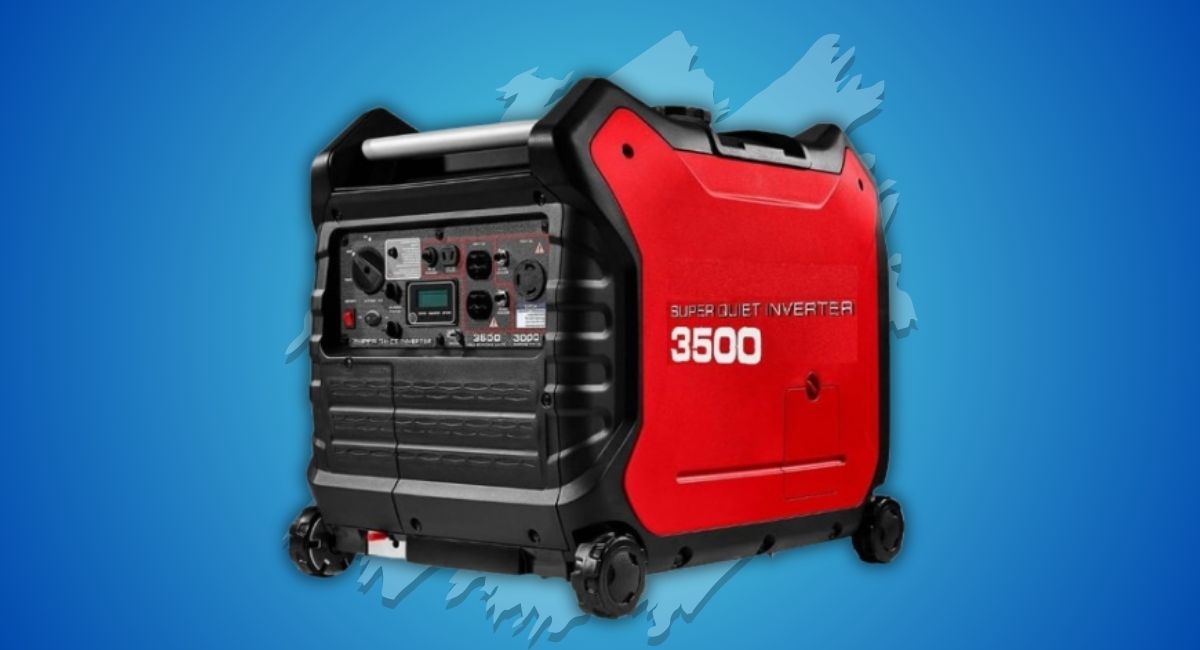
Predator 3500 Inverter Generator Review
The Predator 3500 is a quiet, powerful generator from Harbor Freight that many campers and RV owners love. It gives you 3,500 starting watts and 3,000 running watts — enough to power an RV, charge your devices, or keep essentials running during a power outage. It starts with the push of a button, runs up to 11 hours on a tank of gas at light use, and stays quiet enough to talk over.
But it’s not perfect. It’s heavy (about 102 pounds), it only puts out 120 volts (so no 240V appliances), and the base warranty is just 90 days. In this review, we’ll walk through its specs, noise level, fuel use, outlets, safety features, and limits — and compare it to other generators — so you can decide if it’s right for you.
Who Should Buy the Predator 3500?
The Predator 3500 may be a suitable choice for:
- RV owners: Those whose electrical requirements fit the generator’s 120V output and available receptacles.
- Campers and outdoor users: People who need more power than a small portable generator can supply, provided the location allows generator use.
- Homeowners preparing for outages: Those who want to power selected essential appliances rather than an entire home.
- Budget-conscious buyers: People who find the Predator at an attractive price and are comfortable with its capacity, weight, and warranty terms.
It may be a poor fit for buyers who need 240V equipment, whole-house backup, factory-supported dual-fuel operation, or a generator that is easy to lift into a vehicle.
Before buying, list the appliances you intend to run and calculate their combined running watts and starting requirements. That simple step is more useful than choosing a generator based only on its advertised peak output.
Pros
Cons
- Provides 3,000 running watts and 3,500 starting watts.
- Enclosed inverter design is suitable for many portable-power applications.
- Electric start is convenient.
- Includes wheels and a handle for repositioning.
- Published runtime reaches up to 11 hours at 25% load.
- Offers a 120V 30A locking receptacle for compatible equipment.
- Provides a 12V DC output in addition to its AC outlets.
- Weighs approximately 99 pounds before fuel.
- Runs on gasoline rather than offering factory-supported propane or natural-gas operation.
- Supplies 120V power rather than 240V.
- Runtime varies with load and conditions.
- Published noise figures apply to specified testing conditions, not every situation.
- Does not have dedicated USB charging ports on the versions covered by the cited manuals.
- Check the tank size for your specific model.
What Is the Predator 3500 Inverter Generator?
The Predator 3500 is built for people who need more power than a small camping generator can provide but do not necessarily need a large conventional generator.
Its 3,000-watt rated output can support several everyday electrical loads, provided their combined consumption stays within the generator’s capacity. It may be useful for powering selected appliances during an outage, operating equipment at a campsite, or supplying electricity to an RV.
The enclosed inverter design is another important feature. Unlike a traditional open-frame generator, the Predator 3500 uses an enclosed body around its engine and electrical components. Its inverter system also produces power suitable for many modern electronic devices.
However, its output should not be confused with a whole-house generator. It provides 120V power, so equipment requiring 240V cannot be powered directly by this model.
The most important question is whether its available wattage, fuel requirements, and portability match your intended use.
Design and Build Quality
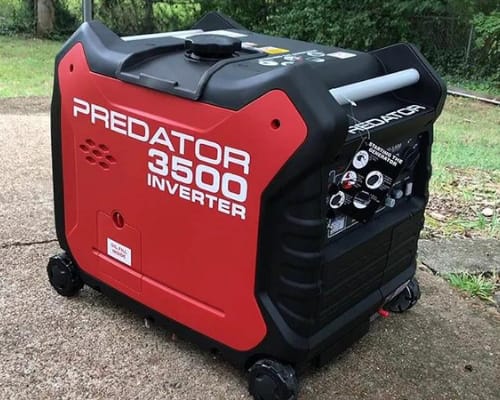
The Predator 3500 has an enclosed body that protects many of its working components from direct exposure. The enclosure also gives it a more compact appearance than many open-frame generators in a similar power category.
Its built-in wheels and carrying handle make it easier to reposition across a reasonably level surface. This is helpful when moving it between a vehicle, campsite, storage area, or suitable outdoor operating location.
Weight remains an important limitation. At approximately 99 pounds before fuel, it is not something most people will want to lift repeatedly without assistance. The wheels help with movement, but lifting the unit into a vehicle can still require considerable effort.
Its enclosed construction should not be treated as proof that every internal component is more durable than those in competing generators. Long-term reliability depends on component quality, operating conditions, and how well the machine is cared for.
Overall, the design is practical for users who need a generator that can be rolled into position, but it is less convenient for anyone who prioritizes low weight.
Engine and Power Performance
The Predator 3500 uses a 212cc, four-stroke, overhead-valve gasoline engine. It supplies mechanical power to the generator system, which converts that energy into electricity.
The rated output is 3,000 watts, while the maximum starting output is 3,500 watts. These two figures serve different purposes.
Running watts indicate the power available for continuous operation within the generator’s rated capacity. Starting watts provide additional short-term capacity for equipment that requires an initial surge when its motor starts.
For example, a refrigerator may use considerably more power during startup than it does once its compressor is running. Similar differences can occur with pumps and air-conditioning equipment.
That does not mean the Predator 3500 can start every appliance with a high starting demand. The actual result depends on the appliance’s starting requirements, the generator’s available capacity, and any other equipment operating at the same time.
Before connecting several appliances, add their running wattages and account for the highest starting demand that could occur when equipment switches on. Avoid exceeding the generator’s rated output during normal operation.
The Predator 3500 can be a useful source of portable electricity, but its suitability depends on the loads you plan to run rather than the starting-watt figure alone.
Fuel Efficiency and Runtime
Harbor Freight’s published specifications list up to 11 hours of operation at 25% load under the stated test conditions. This gives buyers a useful reference for estimating fuel use during relatively light operation.
However, the figure is not a guarantee that every user will get 11 hours from a tank. Actual runtime depends on electrical demand, operating conditions, fuel level, and the specific generator version.
When the connected appliances require more power, the engine generally has to work harder and fuel consumption increases. Running only a few small devices may therefore provide longer operating time than powering several demanding appliances.
The 25% load figure also needs to be understood in context. A quarter of the generator’s 3,000-watt rated output is 750 watts. That is a relatively light load compared with operating near its maximum rated capacity.
If you intend to use the generator overnight, estimate the power requirements of your essential appliances first. A refrigerator, lights, fans, and charging devices may have different consumption patterns, and a compressor or motor can create a temporary increase in demand.
The Predator 3500’s published runtime is useful, but it should not be treated as evidence that the generator will operate for the same number of hours under every load.
Noise Level
The Predator 3500’s published noise figure is approximately 56–57 dB(A) at a distance of 23 feet and a load of 25%, depending on the version.
That measurement provides a reference point for understanding its sound output. It does not mean the generator will always operate at that exact level.
The sound you hear from the generator may vary depending on how hard it is working, where it is placed, and how far away you are when listening. A generator running under a heavier load may sound different from one powering a few small devices.
The enclosed design helps distinguish the Predator 3500 from many open-frame generators, but it should not be described as silent.
For camping or RV use, consider both the published noise rating and where you are permitted to operate the generator. Campsite rules, campground quiet hours, and the distance from neighboring campers can matter just as much as the specification.
Noise rating: 8.5/10. The published low-load measurement is encouraging for an enclosed gasoline generator, although the rating does not represent independently measured noise performance across different loads.
Control Panel and Outlets
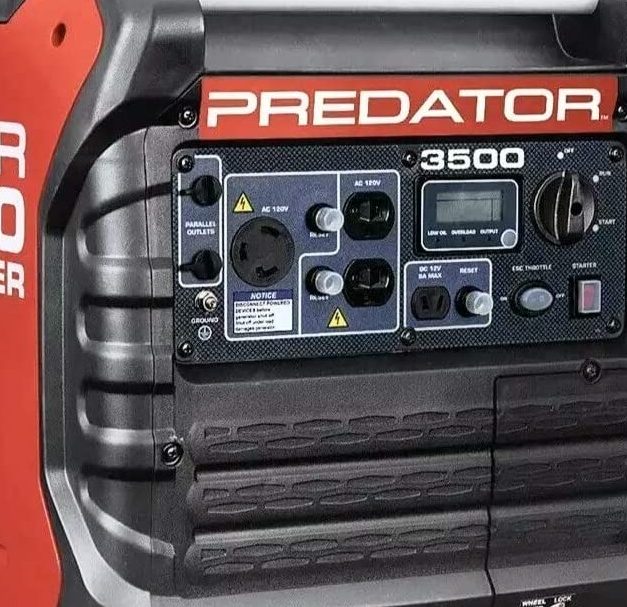
The Predator 3500 offers a combination of AC receptacles and a 12V DC output for different electrical needs.
Its two 120V 20A receptacles can supply compatible household-style plugs. The 120V 30A locking receptacle provides another connection option for compatible equipment, including some RV power connections when the correct cord and electrical arrangement are used.
The generator also has a 12V DC outlet rated at 8A nominal. This is separate from its AC output and should be used only with compatible equipment.
The outlet arrangement is useful for common portable-power applications, but buyers should check the exact connections required by their appliances before purchasing.
The 30A receptacle does not mean that the generator can supply 30A at 240V. This model is a 120V generator. Its available output remains limited by its rated power capacity.
It is also important not to assume that an outlet’s current rating represents the amount of power the generator can provide continuously. The combined connected load must stay within the machine’s overall limits.
Safety Features
The Predator 3500 includes protective features such as low-oil protection and overload indication. These help the operator identify certain operating problems, but they do not eliminate the need to use the generator correctly.
Low-oil protection can help prevent engine damage associated with insufficient oil. Overload protection or indication helps alert the operator when the electrical demand exceeds what the generator can handle.
These features are useful, but they cannot protect against every electrical or operating hazard. Use compatible cords, avoid damaged connections, and follow the instructions in the owner’s manual.
Carbon monoxide safety is especially important. The generator produces exhaust containing carbon monoxide, a poisonous gas that cannot be seen or smelled.
Always operate it outdoors, at least 20 feet from homes and other occupied structures where the manufacturer’s safety instructions require that separation, with the exhaust directed away from doors, windows, and vents. Never operate it inside a house, garage, tent, or other enclosed or partially enclosed space. Refer to the manual for any other safety steps you need to follow.
Use a carbon monoxide alarm inside your home, and never connect a portable generator directly to household wiring without a properly installed transfer arrangement handled by a qualified electrician.
The generator’s protective features are valuable, but safe placement and correct electrical connections remain essential.
Predator 3500 vs. Honda EU3000iS
The Honda EU3000iS and Predator 3500 both target buyers looking for enclosed inverter generators, but they have different strengths.
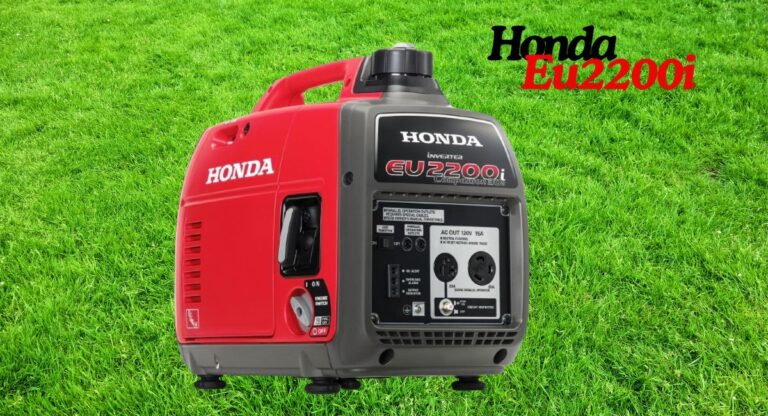
The Predator 3500 offers 3,000 running watts and 3,500 starting watts. The Honda EU3000iS is rated at 2,800 running watts and 3,000 starting watts.
That gives the Predator a higher published wattage rating, while the Honda is known for its longer published runtime under specified light-load conditions and its CO-MINDER carbon monoxide detection system.
The two models should not be compared solely by their starting-watt figures. Purchase price, warranty, local parts availability, weight, noise specifications, and intended use all matter.
Which is better? The Predator may appeal to buyers who need its higher rated output and find it at a competitive price. The Honda is worth considering for buyers who prioritize its particular safety features, established product support, and published operating characteristics.
Predator 3500 vs. Westinghouse iGen4500
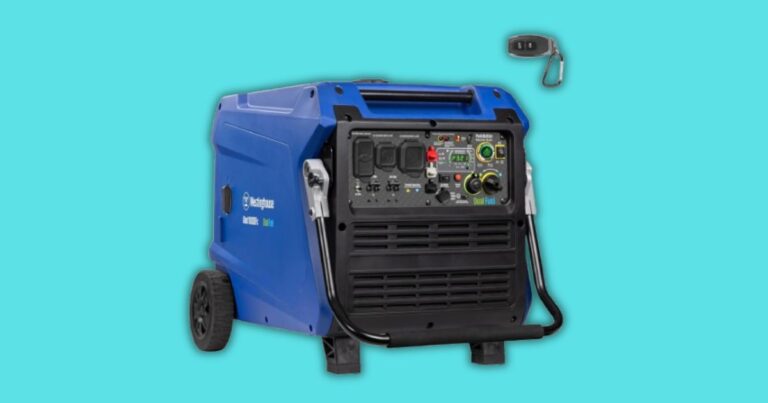
The Westinghouse iGen4500 is a higher-output alternative for buyers who need additional capacity. Its published ratings are 3,700 running watts and 4,500 peak watts, compared with the Predator’s 3,000 running watts and 3,500 starting watts.
The extra capacity can be useful when operating several appliances or equipment with demanding startup requirements. However, a higher rating does not automatically make a generator the better purchase for everyone.
The Predator may be sufficient for buyers whose combined loads remain within its 3,000-watt rating. Choosing the smaller unit can make sense when its capacity meets the actual requirement and its purchase price is more attractive.
Before deciding, compare the exact versions’ weight, runtime conditions, outlets, noise measurements, and current prices.
Predator 3500 vs. Generac iQ3500
The Generac iQ3500 is another enclosed inverter generator in the same general power category. Both models are designed for portable electricity rather than 240V whole-house applications.
The Predator 3500 is rated at 3K running and 3,500 starting watts. Generac also markets the iQ3500 as a 3,500-watt-class inverter generator, but buyers should compare the published continuous and starting ratings rather than relying on the model names alone.
Look closely at the control layout, starting options, outlet configuration, weight, warranty, and price for the specific versions available to you.
Which should you choose? The Predator is worth considering when its price and 120V output meet your needs. The Generac deserves consideration if its specific features, support, or available warranty provide a better fit. Verify current specifications before making a final comparison.
I also recommend to check what can a 3500 watt generator run. You can run most kitchen appliances that are available on versusandreviews.us.
Final Verdict
The Predator 3500 is a practical option for buyers who need an enclosed gasoline inverter generator with 3,000 running watts. Its electric start, wheels, range of 120V connections, and published runtime make it worth considering for selected RV, camping, and home backup applications.
Its limitations are equally important. The unit weighs approximately 99 pounds, operates on gasoline, and does not provide 240V power. The advertised runtime also applies to a specified light-load condition rather than every operating situation.
I would shortlist the Predator 3500 if its available power matches your appliances and its price compares favorably with alternatives. I would look at a higher-output generator for more demanding loads and a lighter model if frequent lifting is a priority.
The best choice depends on the equipment you need to run, the operating time you expect, and the total cost of ownership. Check the exact model’s owner manual and warranty before purchasing, especially if the generator will be used regularly for RV trips or emergency backup.
Unfottunately, this model is not available on Amazon. However, I recommend you to check Generac IQ3500 which better than Predator.
Frequently Asked Questions
Is the Predator 3500 a good inverter generator?
It can be a good option for users who need up to 3,000 running watts of 120V power. Your best option depends on power needs, price, warranty, and other available models.
How many watts does the Predator 3500 produce?
It is rated for 3,000 running watts and 3,500 maximum starting watts. The starting figure is intended for temporary startup demand, not continuous operation at 3,500 watts.
How long can the Predator 3500 run on a tank of gas?
Published specifications list up to 11 hours at 25% load with a full tank. Actual runtime varies with electrical demand, operating conditions, and the specific model version.
How much oil does the Predator 3500 take?
The manuals covered here specify 20 fluid ounces of engine oil, equivalent to 0.625 US quart. Use the oil type and filling procedure in the manual for your exact generator, and check the oil level as instructed.
Is the Predator 3500 quiet?
The published noise figure is approximately 56–57 dB(A) at 23 feet and 25% load, depending on the version. Noise will vary with load, distance, and surroundings.
Can the Predator 3500 power an RV?
It can supply compatible 120V RV equipment through the appropriate outlet and cord. Whether it can run an RV air conditioner and other appliances simultaneously depends on their combined running watts and startup demand.
Can I connect two Predator generators in parallel?
Only use a parallel connection when the manufacturer explicitly approves the exact generator models and specifies a compatible parallel kit. Do not assume that the Predator 3500 can be paired with any 2,000-watt generator. Read both manuals before connecting the generators.
Can the Predator 3500 run a whole house?
It is not a whole-house generator and does not provide 240V output. It runs compatible appliances within its power limit when connected safely. Household wiring should be connected through a properly installed transfer arrangement.
Does the Predator 3500 use gasoline or propane?
The versions covered in this review use gasoline. Do not assume that propane or natural gas is supported unless the manufacturer specifically approves the equipment and conversion for the exact model.
Where can I find the correct Predator 3500 specifications?
Check the model or item number on the generator and consult its matching owner’s manual. This is particularly important for fuel-tank capacity, noise specifications, and other details that can differ between production versions.